You can post a job for free: Indeed allows up to three free job posts per calendar month for employers who post directly, government job banks cost nothing, and Google for Jobs shows your listing at no charge if your career page carries job-posting markup. The limit is not price but reach: free posts only reach people who are already searching, and they lose visibility over time. For nursing, trades, logistics or hospitality, where few people search actively, a small ad budget on Instagram and Facebook usually has to follow. As of October 2026.
How we checked these options
We read each provider's terms on 3 October 2026 and cross-checked them against help pages and press coverage. A way counts as free here if you can publish a job without paying a fee. We count monthly caps, run time, visibility and your own time as the limits. Terms change quickly, so confirm them with the provider before you post.
The 9 ways at a glance
| # | Way | Cost | Limit | Best for |
|---|---|---|---|---|
| 1 | Indeed, posted directly | $0 | 3 posts a month, 30 days each, visibility fades | most roles, active job seekers |
| 2 | Government job banks | $0 | account setup, local reach, varies by state or country | hourly and trade roles, local hiring |
| 3 | Google for Jobs via your career page | $0 | needs JobPosting markup, no guaranteed placement | employers with their own website |
| 4 | Free job boards and aggregators | $0 | small reach, niche focus, monthly caps | an extra channel with little effort |
| 5 | Community colleges, schools, associations | usually $0 | regional, mostly entry level | trades, apprenticeships, entry roles |
| 6 | Window signs, vehicles, QR codes | a few dollars | local foot traffic only | retail, restaurants, field service |
| 7 | Organic posts and local groups | $0 | reaches mostly existing followers | businesses with an active community |
| 8 | Referrals and your own network | $0 to a bonus | does not scale, depends on your team | every employer, as the first lever |
| 9 | Paid social on a small budget | from about €1,000 | costs budget, needs an ad and pre-screening | roles where nobody searches actively |
1. Indeed: three free posts a month
Since 10 December 2025, employers who post directly on Indeed can publish up to three free job posts per calendar month, each live for up to 30 days. According to Indeed the rule covers the US, Canada, Germany, the Netherlands and the UK. Job boards and staffing agencies are excluded from the free tier.
The limit is stated by the provider itself: free posts lose visibility over time, and Indeed sells sponsored jobs that it says bring about 50 % more applications in Germany. Sponsored posts are billed by the day or per application, depending on the market, so check what you will pay before you upgrade.
2. Government job banks
In the US, state workforce agencies and American Job Centers let employers list openings at no cost. In the UK, employers can advertise through the government's Find a job service. They are strongest for hourly, trade and entry roles and for hiring locally. Setup takes time, and the reach is regional, so treat them as a base layer, not the whole plan. Check your own state or agency for current terms.
3. Google for Jobs via your career page
Google shows jobs directly in search results, at no cost. Your job page needs JobPosting structured data. If you would rather not touch your site, your listing can also appear in Google for Jobs when you publish through job boards that Google already indexes.
This is the cheapest lasting route, because the listing lives on your site and does not expire after 30 days. The limit: Google guarantees no placement, and a career page without visitors produces few applications.
4. Free job boards and aggregators
Beyond the big names there are many free boards, some with monthly limits and some focused on a niche such as tech or sustainability. Some aggregators publish an unlimited number of listings for 30 days. They work as a low-effort extra channel. Do not expect volume. Craigslist, once the default for local hiring, charges for job posts in many markets, with reports of around $75 in large metros.
5. Community colleges, schools and associations
Many community colleges, trade schools, universities and industry associations run their own job boards, usually free for employers. They are regional and suited to apprenticeships, entry roles and graduates. A short call to the placement office often gets you listed quickly.
6. Window signs, vehicles and QR codes
For retail, restaurants and field service, analog still works. A sign in the window or on a company vehicle with a QR code reaches people who already know your business. Send the code to a mobile application with no resume. The limit is obvious: only people who pass by see it.
7. Organic posts and local groups
A post on your business page costs nothing, but it mostly reaches your existing followers, and those are usually customers, not applicants. Local groups and short stories showing a real workday perform better than a plain graphic. Meta began retiring its dedicated Jobs on Facebook feature in 2022, so organic posts are ordinary posts with no job tools attached. Expect few applications, but good credibility.
8. Referrals and your own network
The underrated route. In German data from the IAB job vacancy survey, reported by Deutsche Handwerks-Zeitung, searches through personal contacts led to a hire in 62.7 % of cases, and in firms with fewer than ten employees 46.6 % of hires came that way. The survey is older, but referrals remain the cheapest channel most employers have. Ask your team, suppliers and customers, and make it easy: one link, one message, a small bonus.
9. Paid social on a small budget: the bridge
If the free routes bring no applicants, the ad is rarely the problem. Often your audience is not searching. A nurse, a driver or an electrician scrolls Instagram and Facebook in the evening, not job boards. A paid ad reaches them there.
Meta applies limits to job ads in the US, Canada and more than 40 European countries: you must pick the special ad category for employment, age and gender cannot be targeted, and location targeting needs a radius of at least 15 miles or 25 km. Technically a few euros a day is enough. For a meaningful test, practitioner sources suggest roughly €18 to €45 a day for seven to fourteen days. As a worked example, €30 a day for 30 days comes to €900, which is why planning gets reliable from about €1,000 of budget. A US benchmark of 891 managed Meta campaigns in 2026 put the median cost at $13.88 per application, with a spread from $2.91 to $66.45. Outcomes depend heavily on role, region and pay, and nobody can promise a number of applicants.
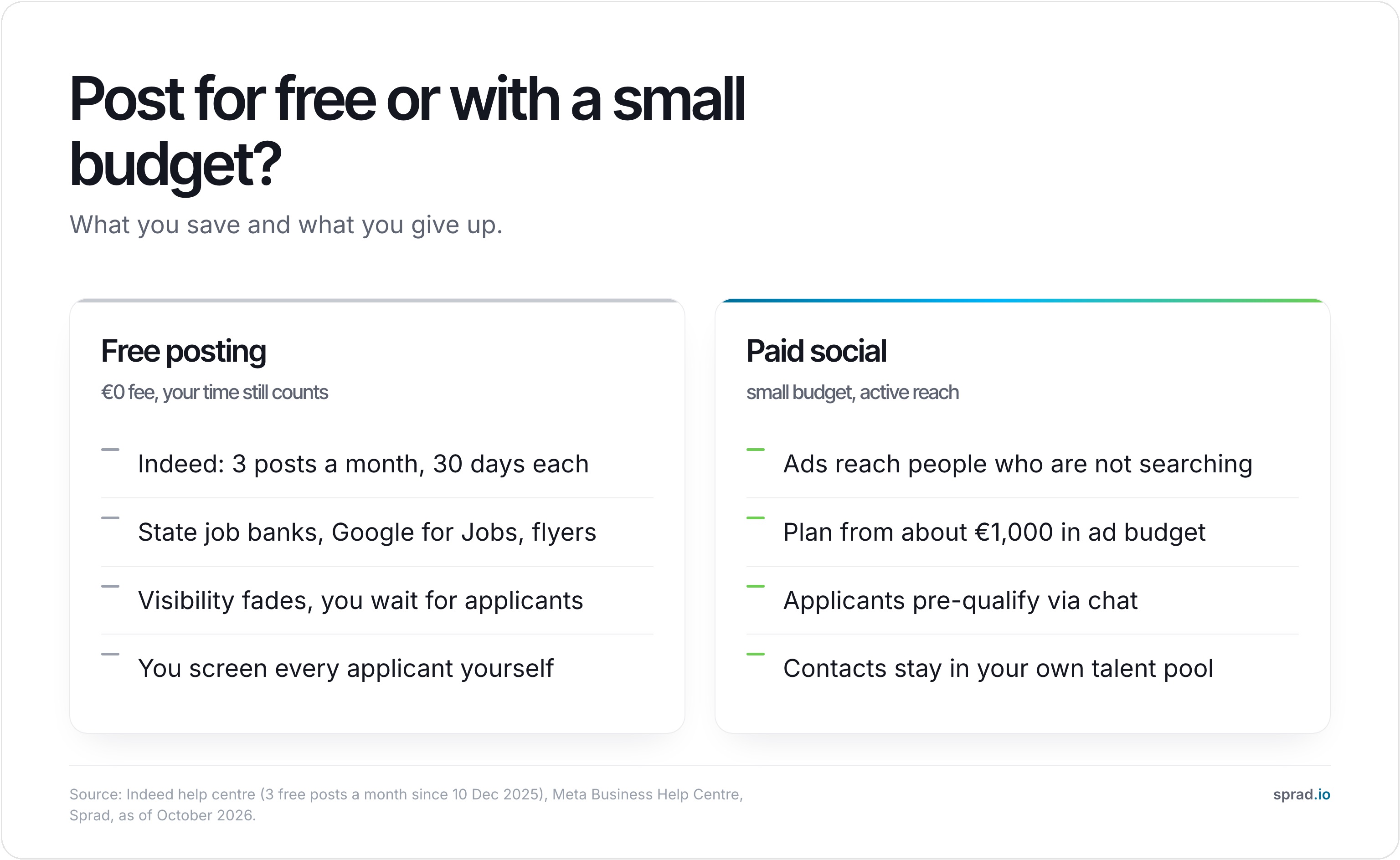
What "free" really costs
Free means no fee, not no effort. As a worked example, assume five hours per role for the ad, upkeep, replies and screening at €40 of internal cost per hour: €200 of working time per role, even if no suitable application arrives. With three open roles that is €600. These numbers are assumptions, so plug in your own.
The bigger risk sits elsewhere. Every application sorted by hand ties up time, and many applicants never reply. For frontline roles many people only want to answer quickly from a phone, not fill in a form. We describe the alternative in Frontline recruiting: phone and WhatsApp, not email, and the rules in contacting candidates via WhatsApp.
An order that works
- Set up your career page and Google for Jobs. This is the base that stays.
- Use job banks and Indeed. Both cost nothing and take half an hour.
- Ask for referrals. A link, a bonus, a reminder in the team meeting.
- Review after two to three weeks. If applications fall short, add a small social budget.
- Pre-screen applicants and keep them in a pool. Today's rejections are tomorrow's applicants.
Where Sprad fits in
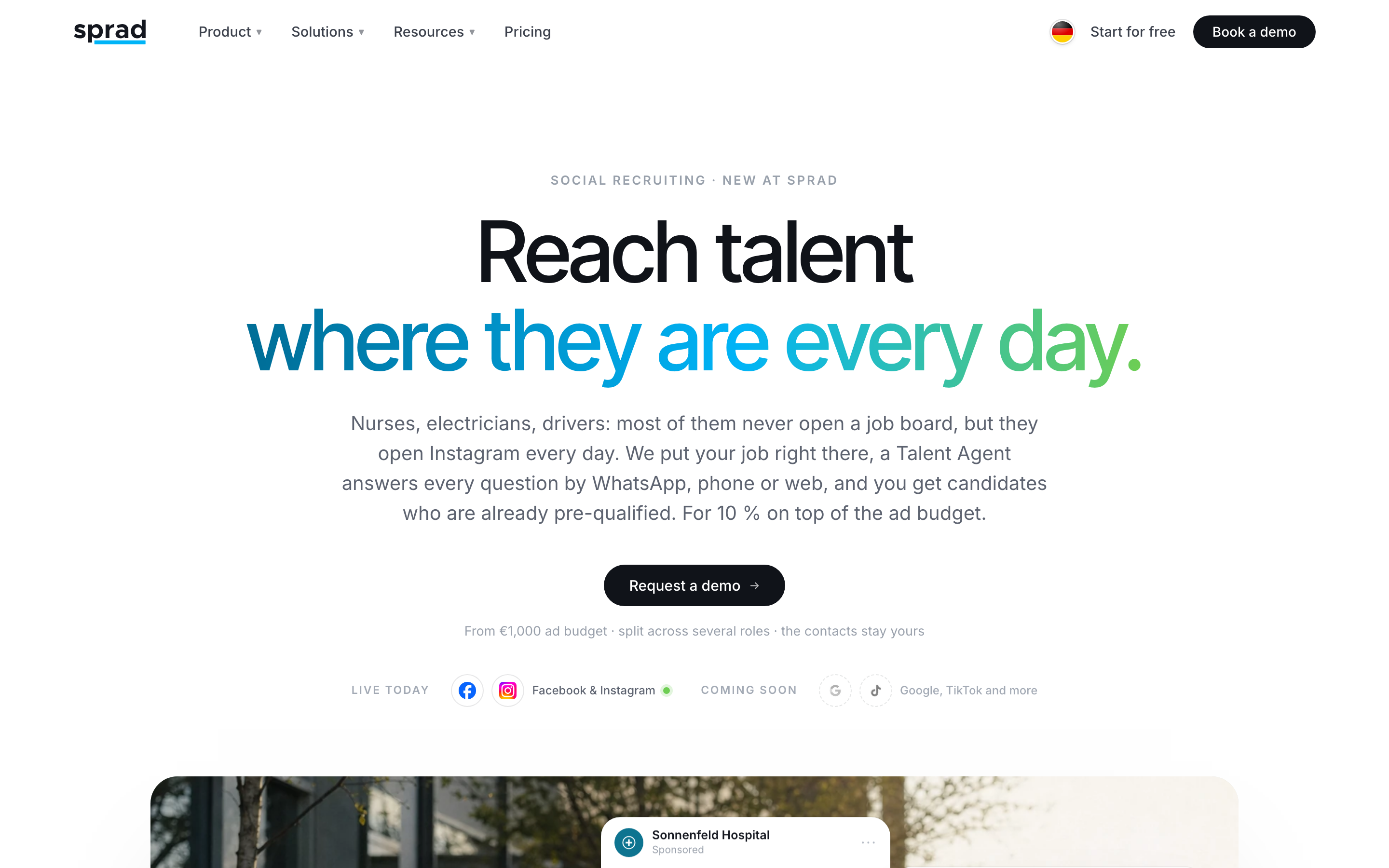
Sprad Social Recruiting runs job ads on Instagram and Facebook, where nurses, tradespeople, drivers and other frontline workers spend time every day. An AI talent agent pre-screens every applicant via WhatsApp, phone or web. Every applicant lands in the employer's own talent pool, so the relationships stay with the employer instead of a platform. Pricing is ad spend plus 10 %, from a €1,000 budget that can be split across roles, with three months recommended. See Sprad Social Recruiting, the trades page, and the Talent Base.
FAQ
Can I really post a job for free?
Yes. Indeed allows up to three free posts a month, government job banks and Google for Jobs cost nothing, and many smaller boards are free. Your time and the limited reach remain.
Where is the best place to post a job for free?
For most employers, a career page with Google for Jobs markup, a government job bank and Indeed make the best combination. For apprenticeships, add schools and associations.
How long does a free job post stay up?
On Indeed, up to 30 days per post. Other boards set their own run times, and a listing on your own career page can stay as long as you keep it.
Why do my free job posts get so few applications?
Typical causes are low visibility, an unclear title, no pay range and a long application path. For roles where few people search, paid reach on social media helps.
When does paid social recruiting pay off?
When free routes bring too few suitable applicants after two to three weeks, or when your audience hardly uses job boards. From about €1,000 of budget you can test a role in a planned way.
Can I contact applicants on WhatsApp?
Yes, if the applicant started the chat or agreed to it. Rules differ by country, see our guide on contacting candidates via WhatsApp.
More on social recruiting
Jürgen Ulbrich
Jürgen Ulbrich has more than a decade of experience in developing and leading high-performing teams and companies. As an expert in employee referral programs as well as feedback and performance processes, Jürgen has helped over 100 organizations optimize their talent acquisition and development strategies.