Performance recruiting means buying job-ad reach through measurable digital campaigns and steering the budget by numbers such as cost per click, cost per applicant and cost per hire, instead of paying a fixed price for a listing. Typical campaigns cost roughly €1,000 to €2,500, depending on audience, reach and clicks. It works best for roles with many applicants per vacancy or where candidates are not searching, and it fails when nobody checks applicant quality.
What is performance recruiting?
The idea comes from performance marketing. A recruiter runs ads on Google, Facebook, Instagram or job aggregators, tracks every step from impression to hire and moves money towards what works. In German-speaking markets the term is explained as KPI-driven recruiting with digital campaigns. In the US the same approach is usually called programmatic job advertising, where software buys placements in real time and adjusts bids by performance.
Three things set it apart from a classic job listing:
- Budget instead of listing: you fund a campaign, not a posting with a fixed run time.
- Measured outcome: clicks, applications and hires are tracked per channel and per role.
- Continuous optimisation: the budget moves to better channels while the campaign runs. DirectEmployers describes automated systems that reallocate budget within 48 to 72 hours.
How performance recruiting is billed
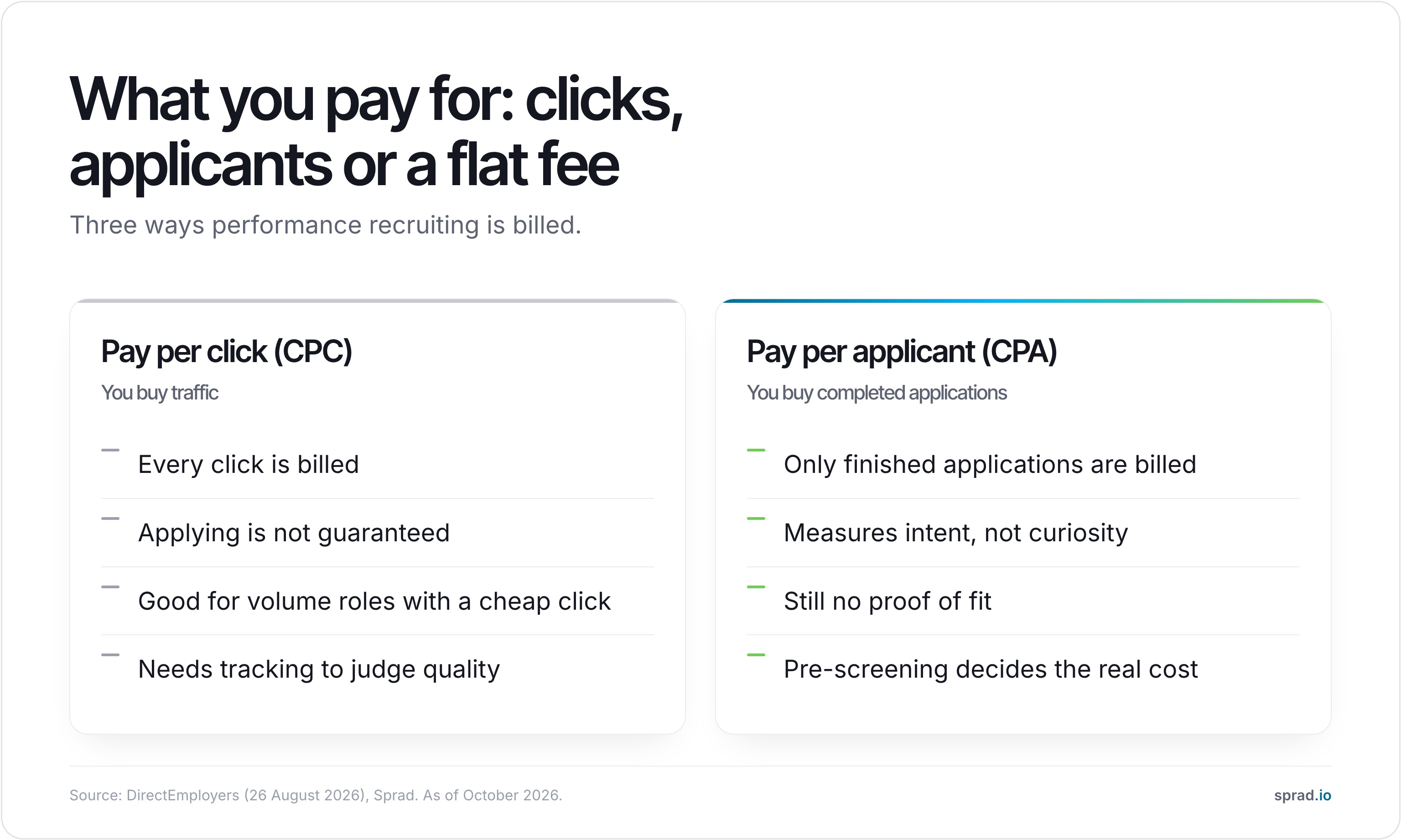
The billing model decides what you actually buy. DirectEmployers (26 August 2026) puts it briefly: cost per click tells you how many people showed up, cost per applicant tells you how many went through with an application.
| Model | You pay for | Typical use | Risk |
|---|---|---|---|
| Cost per click (CPC) | every click on the ad | programmatic buying, aggregators | traffic without applications |
| Cost per applicant (CPA) | each completed application | managed campaigns | applications that do not fit |
| Package per role | a fixed price per vacancy and month | platforms with their own channels | minimum budget and term |
| Commission | a share of the annual salary | recruiting agencies | very high per hire |
| Budget plus fee | ad spend plus a fixed percentage | transparent social campaigns | you carry the reach risk |
What does performance recruiting cost?
There is no single price. As a rough guide, an average campaign lands between €1,000 and €2,500. Published list prices from providers show the spread, all as of 3 October 2026 and without a link to the provider:
| Provider | Model | Listed price |
|---|---|---|
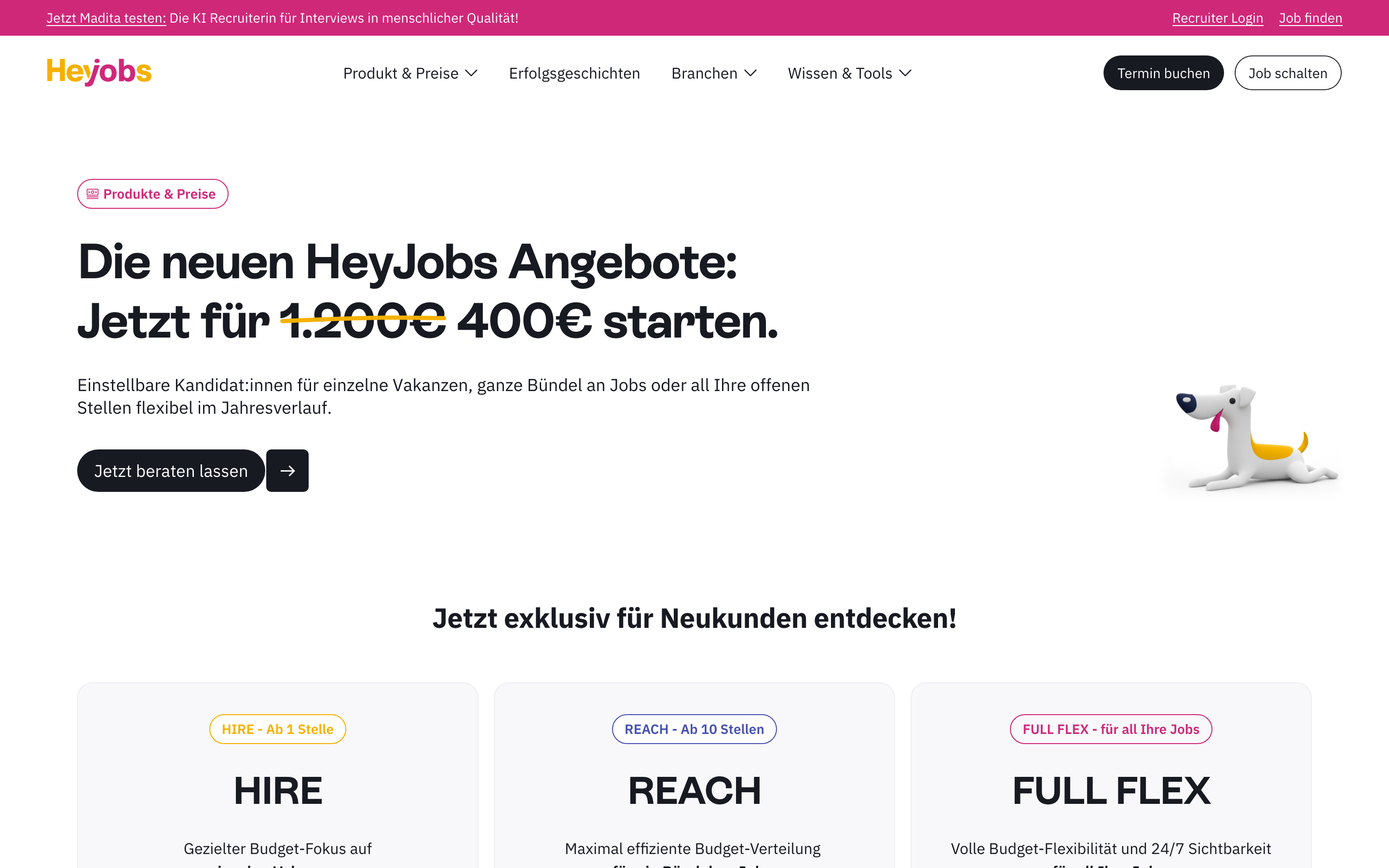
| HeyJobs HIRE | package per role | from €400 per job and month, minimum budget €1,200 |
| HeyJobs REACH | package from 10 roles | under €150 per job |
| TalentBait | campaign | from €700 for 30 days |
| Boostpoint (US) | subscription plus ad spend | at least $750 per month and job category |
| Social Natives | agency per position | €5,000 per position |
| Workwise | commission | 14, 18 or 22 % of the annual salary |
| Sprad Social Recruiting | ad budget plus 10 % | from a €1,000 budget, splittable across roles |
Worked example: one role and five roles
Take the HeyJobs HIRE minimum budget of €1,200, which equals the recommended three months. Five roles at that price come to €6,000. With ad budget plus 10 %, a €1,000 budget costs €1,100 and a €5,000 budget costs €5,500, and you can spread it across roles. Both figures are arithmetic on listed prices. They say nothing about how many applicants you receive.
For applicants, the best public yardstick comes from the US. The Boostpoint benchmark 2026 reports a median of $13.88 per applicant across 891 Facebook and Instagram campaigns, ranging from $2.14 for warehouse roles to $74.62 for therapy roles. A $3,000 budget would therefore buy roughly 216 applications at the median (3,000 divided by 13.88). That is a US benchmark, not a promise for your region.
Where it works and where it does not
Performance recruiting pays off when candidates are reachable by an ad. The Appcast benchmark report (17 February 2026) shows how much it depends on the role: office roles drew high apply rates, healthcare roles that require standing were expensive to fill, and rural states had the highest advertising costs. The same report attributes the 2025 rise in cost per application to changes in job board pricing and programmatic media models.
- Works well: volume roles in logistics, retail and hospitality, shift work, regions where job boards bring few applicants, continuous hiring for the same roles.
- Works less well: highly specialised roles with a handful of candidates worldwide, roles that need a long employer story, one-off hires where the learning curve is not worth it.
The hidden costs
- Applicant quality: a cheap application that you must chase by phone costs staff time. Look at cost per qualified applicant, not per click.
- Minimum budget and term: many packages need about three months before the algorithm settles.
- Who owns the pool: on most platforms the candidate database belongs to the platform. You pay again for the same reach with the next vacancy.
- Targeting limits: for Meta's employment category, targeting by age, gender and postal code is restricted in the US, Canada and certain European countries. Check the current rules for your market before you plan.
Performance recruiting with HeyJobs
HeyJobs is the best-known German provider and titles its home page "performance recruiting". It sells budget packages that run across its channels and its own candidate pool.
See our guide to StepStone costs for the classic job board price list.
How to start without wasting budget
- Pick one role with many open positions and write down the number you need per month.
- Set the metric first: cost per qualified applicant, not clicks.
- Pre-screen every applicant by phone or WhatsApp, see why frontline recruiting works by phone and WhatsApp, not email.
- Run for three months before judging, and check consent rules for messaging in our guide on contacting candidates via WhatsApp.
- Keep every applicant in your own database so the second role costs less reach.
The Sprad approach: your own pool instead of rented reach
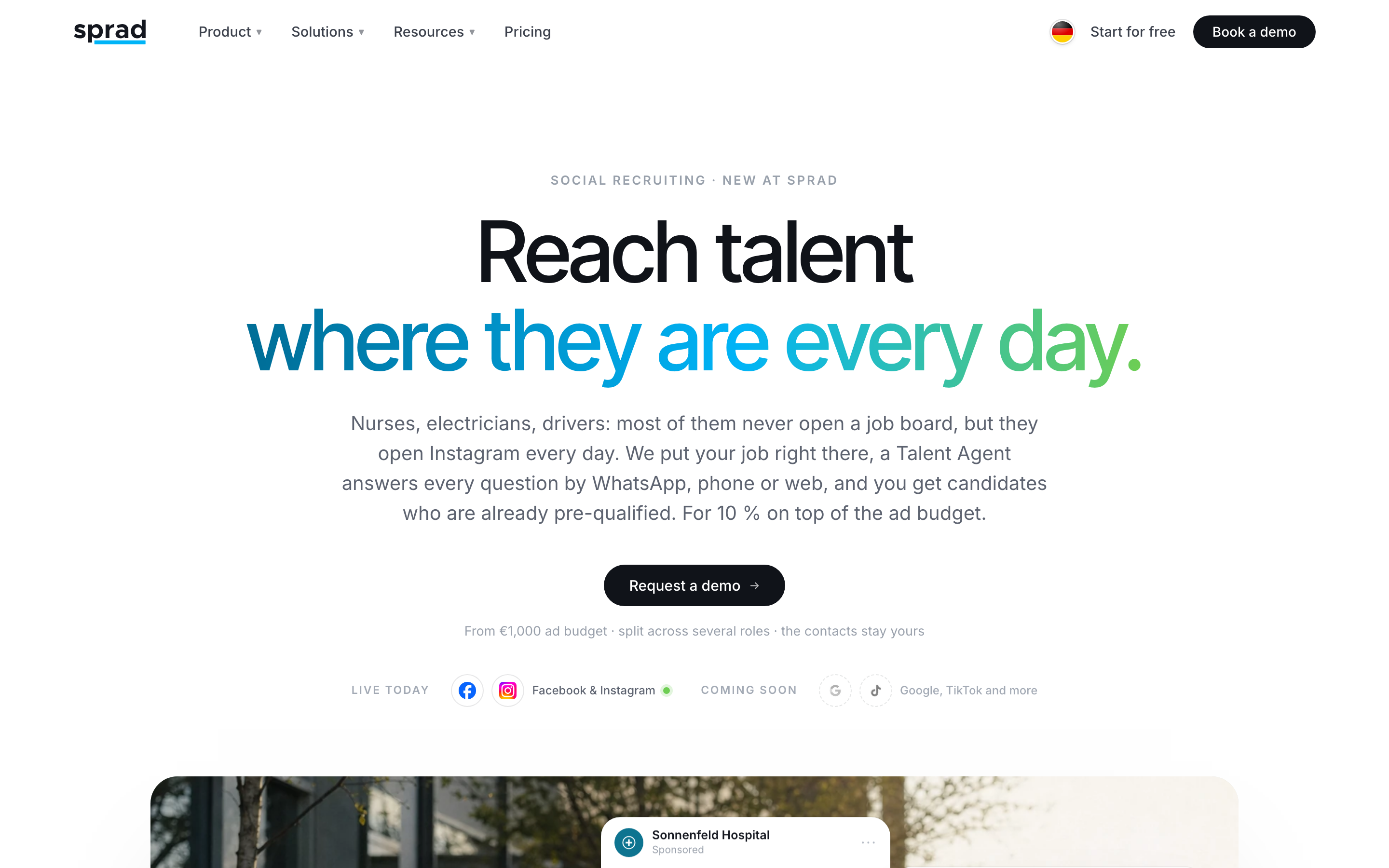
Sprad Social Recruiting runs job ads on Instagram and Facebook, where nurses, tradespeople, drivers and other frontline workers spend time every day. An AI talent agent pre-screens every applicant via WhatsApp, phone or web. Every applicant lands in the employer's own talent pool, so the relationships stay with you instead of a platform. Pricing is ad spend plus 10 %, from a €1,000 budget that can be split across roles. Details on Sprad Social Recruiting, relevant industries are logistics and trades.
FAQ
What is the difference between performance recruiting and programmatic job advertising?
Programmatic job advertising is the automated buying of ad placements with bids that adjust to performance. Performance recruiting is the broader approach: campaigns steered by measured results, whether bought programmatically or run manually.
How much does performance recruiting cost per hire?
That depends on role and region. Public benchmarks, such as the Appcast report, show wide differences between office and frontline roles. Calculate your own number: total ad spend divided by hires from the campaign.
Is performance recruiting only for large companies?
No. A campaign can start in the low four-figure range. The limit is how many roles you can fill, since learning takes a few weeks.
Is cost per applicant better than cost per click?
It measures intent rather than curiosity, but it still does not prove fit. Pre-screening decides the real cost per qualified applicant.
Do I need a minimum budget?
Providers set their own: HeyJobs lists €1,200 for HIRE, Boostpoint at least $750 per month and category. Sprad starts at a €1,000 ad budget plus 10 %.
More on social recruiting
- HeyJobs pricing 2026: packages, minimum budget and real costs
- Recruiting on Instagram: job ads, stories and reels that get applicants
- WhatsApp recruiting: let candidates apply and get pre-screened via WhatsApp
- How much does social media recruiting cost? Budgets, cost per applicant, examples
- The complete social recruiting guide
Jürgen Ulbrich
Jürgen Ulbrich has more than a decade of experience in developing and leading high-performing teams and companies. As an expert in employee referral programs as well as feedback and performance processes, Jürgen has helped over 100 organizations optimize their talent acquisition and development strategies.