A job signal is any public sign that a company is about to hire, or already struggling to: a new posting, a cluster of open roles in one team, a funding round, a newly hired VP of Talent reviewing every vendor relationship. Recruitment business development built around these signals means reaching the prospect in the week they actually have the problem, instead of pitching 500 accounts that may or may not be hiring at all. It's not a new idea, but 2026's tooling makes it far easier to run systematically instead of opportunistically — and the agencies that do it consistently outperform the ones still working a cold list.
What counts as a hiring signal
The most direct signal is the obvious one: a live job posting on the company's careers page or a job board, in a function you specialize in. But a posting is a lagging indicator — plenty of your competitors see the same ad. Earlier, weaker signals are often more valuable precisely because fewer agencies act on them:
- Headcount growth clustered in one team (visible on a company's page on a professional network) usually precedes a wave of postings by weeks.
- A funding round or new office announcement almost always triggers a hiring push shortly after.
- A newly hired VP of Talent, Head of People, or Ops leader is actively reviewing vendor relationships in their first 90 days — the best window to introduce yourself.
- A competitor's public complaint about slow time-to-fill, on G2, Capterra or elsewhere, is a signal that their current process isn't working.
- A role reposted after weeks open, or quietly refreshed, is arguably the single strongest signal on this list: it means the search already failed once, whoever owns the seat has already felt the cost of it, and they're the warmest "cold" contact you'll find.
One widely cited vendor estimate puts 40–60% of newly raised venture funding toward hiring within the first 12 months — treat that as directional industry lore rather than an audited figure, but it's the logic behind why a funding round is worth tracking even before any role appears.
Why timing beats volume
The logic isn't complicated: a message that references a real, current hiring need lands differently than a generic pitch. In an account of this approach published by ZoomInfo, a senior sales manager describes reaching out to companies specifically because they had open positions posted, and getting "a distinct increase in win-rate without changing a thing about our sales cycle." The same piece recounts, as an anecdote rather than a controlled study, a three-person recruitment shop that focused outreach on companies actively posting relevant roles and landed a Fortune 1000 account within three months. Neither claim comes with a published percentage, and you should treat them as directional rather than a guaranteed multiplier — but the underlying mechanic holds regardless of the exact number: timing relevance beats blind volume.
Timing a funding signal is its own trade-off: a congratulatory touch within 48 hours keeps your name on the radar, but the real hiring wave usually only starts 8–12 weeks later, once the board has signed off on headcount — so save the substantive, role-specific follow-up for that window instead of the announcement itself.
Where to actually find these signals
You don't need expensive tooling to start. A manual, disciplined process beats an automated one nobody runs:
- Target-account careers pages, checked weekly for your list of 30–50 accounts — free, but doesn't scale past a small list.
- Job board searches filtered to your specialism and a handful of target industries, refreshed on a schedule.
- A professional network's company-page "jobs" tab and job-change notifications, especially for contacts moving into hiring-decision roles.
- Google Alerts for combinations of a target company name and role titles you place.
- A dedicated business-development module inside your ATS/CRM. Some AI-native ATS/CRM platforms built for agencies ship a live feature that surfaces companies with fresh open roles directly inside the recruiter's workspace, marketed as spotting "companies that are about to hire, based on real-world signals across your market" — worth a look if you're already evaluating ATS/CRM tools and want signal detection built in rather than bolted on.
- A standalone signal-monitoring service is the other category worth knowing about: a handful of vendors sell nothing but hiring-signal detection — watching job-posting velocity, funding news and leadership moves across thousands of sources and alerting a desk when one of its target accounts lights up, independent of whichever ATS or CRM the agency already runs.
| Signal | Where it shows up | How fast to act |
|---|---|---|
| New job posting | Careers page, job boards | Same week — before the role gets crowded with applicants and other agencies |
| Headcount growth in one team | Company page on a professional network | Within a week — often precedes postings |
| Funding round or new office | Press coverage, funding trackers | Days for a brief congratulatory touch; 8–12 weeks for the substantive follow-up |
| New Talent/Ops leadership hire | Job change on a professional network | First 90 days — vendor relationships are actively being reviewed |
| Public complaint about hiring speed | G2, Capterra, review sites | Opportunistic — reference the specific frustration, not the review itself |
Stack signals instead of acting on one alone
A single signal is a reason to look; two or three together are a reason to call today. A company that just announced a funding round, hired a new VP of Engineering, and posted two backend roles in the same month is showing far more urgency than any one of those facts alone would suggest — and it gives you three concrete details to reference in one message instead of a generic "saw you're growing." Prioritize accounts where several signals land close together over a longer list of single-signal companies; it costs the same research time and the reply rate is usually better.
What to send when you spot a signal
Once you've spotted the signal, the pitch is only half the work — see our companion piece on how requirement search finds candidates a keyword string misses for the sourcing side. For the outreach itself: reference the specific, public role or signal — not the person's private activity. "We noticed you're hiring for two backend roles in Berlin" is a fact anyone can see on a careers page; it's not a private detail about the recipient.
Keep the message short, name the specific role, state one concrete thing you can do about it (a shortlist within a week, access to a passive-candidate pool you already have), and ask for a single next step — a 15-minute call, not a deck. Follow up once, then move on: chasing a cold signal for weeks costs more than moving to the next account.
Where the manual approach breaks down
Checking 30 careers pages by hand every Monday works. Checking 300 doesn't.
Past a certain list size, the choice is between a dedicated signal-tracking tool — whether a general job-board scraper, a BD module built into your ATS/CRM, or a manual weekly rotation split across a team — and simply missing the early window on most accounts. The tooling doesn't replace the outreach; it replaces the hours spent finding the trigger.
How this fits with Sprad, honestly
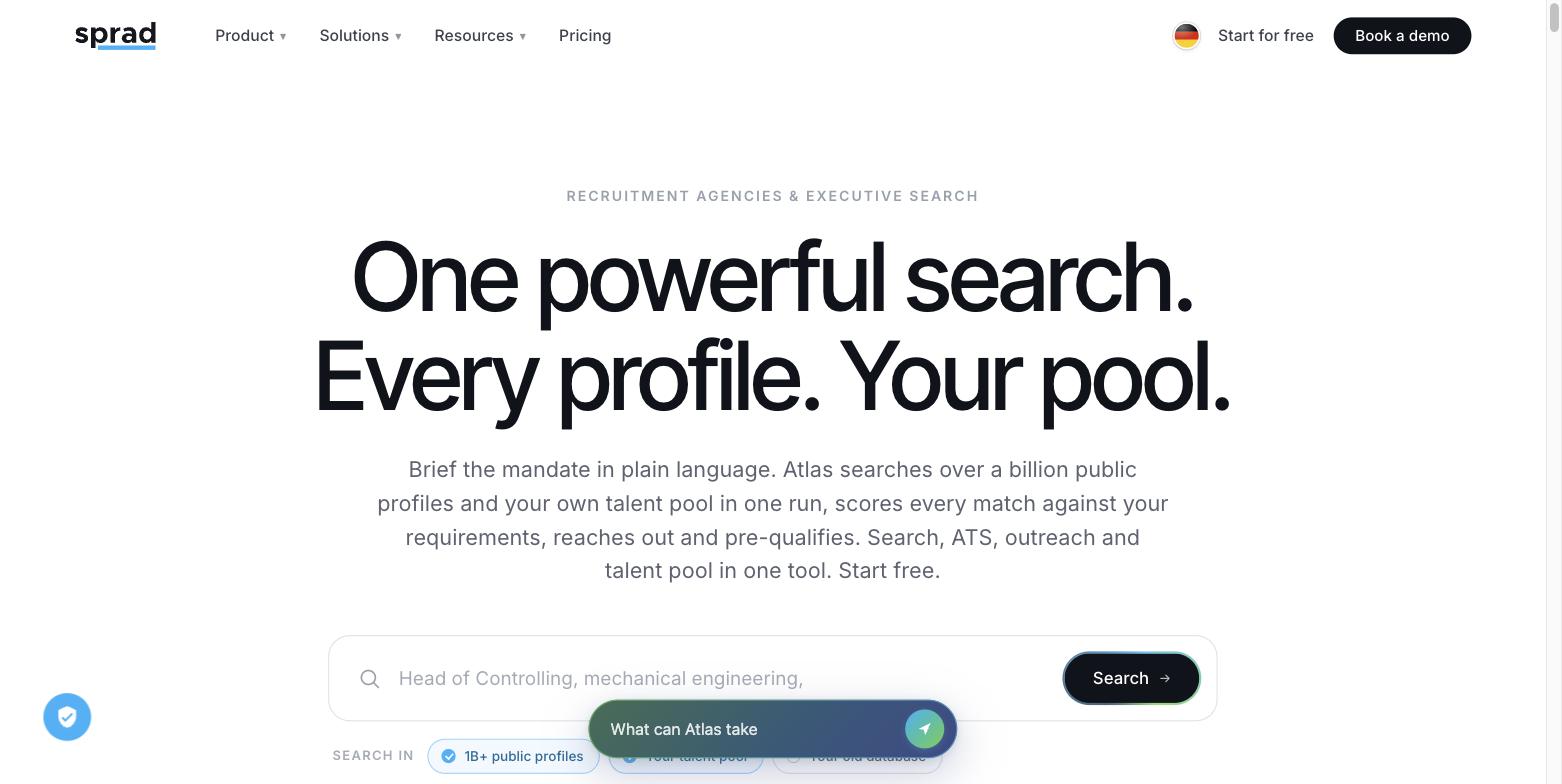
Sprad's strength today sits on the execution side, once you have a mandate: requirement search across more than a billion external profiles — in a public benchmark, it found four times as many matches as the best of four competing tools — at 2 credits — roughly 12 to 16 cents, since 1 credit runs 6 to 8 cents — for each profile that actually clears your criteria, with 200 credits free every month and the resulting pool staying the agency's own. Automatically surfacing which prospective or existing clients have a fresh open role — the signal-detection piece this article is about — is currently in beta at Sprad and not yet a live, sellable feature. If you want to run a systematic job-signal BD process today, pair a dedicated signal tool (or the built-in feature some ATS/CRM platforms already ship) with Sprad for the sourcing and delivery once the mandate is won.
A simple weekly routine
- Monday: sweep your target-account list for new postings, headcount jumps, funding news and leadership changes.
- Prioritize by role count and how directly it matches your specialism — three open roles in your niche outrank one role outside it.
- Send a short, specific message the same day, referencing the exact signal.
- One follow-up after four to five business days if there's no reply, then move to the next account.
- Once a mandate is won, shift the same account straight into sourcing and delivery.
FAQ
What is a hiring signal in recruitment business development?
Any public, observable sign that a company is likely to hire soon or is currently struggling to — a job posting, a headcount jump in one team, a funding round, a new Talent or Ops leader, or a public complaint about hiring speed.
How fast should I reach out after a job posting appears?
The same week, ideally the same day. Postings attract competing agencies fast, and the advantage of a timely signal erodes the longer the role has been visible.
Do I need special software to do signal-based BD?
No. A disciplined manual process across a focused list of 30–50 target accounts works. Software becomes worth it once your list, or the number of people tracking it, grows past what one person can check by hand every week.
Does Sprad show hiring signals for prospective clients?
Not yet as a live feature — automatic customer-signal detection is currently in beta. Sprad's live strength is on the sourcing and delivery side once you have the mandate.
Is signal-based BD only useful for agencies, or also for in-house recruiting?
The tactic is agency-specific by nature — it's about winning new client mandates. In-house teams use similar signal logic differently, mainly for competitive intelligence on talent movement rather than new business.
Are there tools that do nothing but hiring-signal detection?
Yes — alongside the BD modules built into some ATS/CRM platforms, a separate category of standalone vendors sells only signal monitoring (funding news, leadership moves, posting velocity) across thousands of sources and alerts a desk the same day an account lights up. Whether that's worth paying for on top of a manual process depends entirely on how many accounts you're tracking and how much of your week checking them already eats up.
The bigger picture
Cold outreach at volume and signal-based outreach at the right moment aren't the same game, and the second one wins more often for less effort. Once the mandate is signed, the work shifts to finding the right people fast — Sprad's requirement search covers more than a billion external profiles, starts with 200 free credits a month, and builds a talent pool your agency keeps, not one that disappears with a cancelled subscription. See what that looks like for your agency at sprad.io/industry/recruitment-agencies.
Jürgen Ulbrich
Jürgen Ulbrich has more than a decade of experience in developing and leading high-performing teams and companies. As an expert in employee referral programs as well as feedback and performance processes, Jürgen has helped over 100 organizations optimize their talent acquisition and development strategies.