A recruitment chatbot is software that talks to applicants in a chat window or messenger, answers common questions, asks fixed knockout questions and books interviews. For hourly and frontline roles, where people apply from a phone and expect an answer within minutes, a script is often not enough: an AI Recruiter Agent holds a real conversation, reads each CV against your must-have criteria, interviews by chat, voice or WhatsApp and keeps every applicant in your own pool. Since 2 August 2026 the EU AI Act also requires that applicants are told they are talking to an AI (Art. 50).
What a recruitment chatbot does, and where it stops
The classic recruitment chatbot sits on a career site or in one messaging channel. It answers questions about pay, shifts and location, asks two or three yes-or-no questions (work permit, licence, availability) and then books a slot. That is useful: it takes repetitive work off the recruiter and answers at 11 p.m.
The limits show up quickly with hourly hiring:
- It waits. Pin's 2026 buyer guide points out that chatbot-only tools are reactive: they respond when someone writes, and they cannot reach people who never visited the career site.
- It follows a script. Free-form answers like "I can start after the 15th, but only nights" often fall outside the flow, and the applicant is routed to a human or dropped.
- The data stays in the tool. Many chatbots write into the vendor's system or your ATS. A person who is not hired for this role is rarely available as a contact for the next one.
Metaview describes the progression in three generations: first chatbots with predefined intents, then assistants that complete tasks through conversation (its example is Paradox's Olivia), then AI agents you can delegate work to in plain language. Joveo's 2026 chatbot roundup uses a similar idea and calls it "agentic behavior": re-engaging candidates who dropped off, flagging no-shows, surfacing warm past applicants. The labels are not standardized, so judge a tool by what it does, not by what it is called.

What an AI Recruiter Agent adds
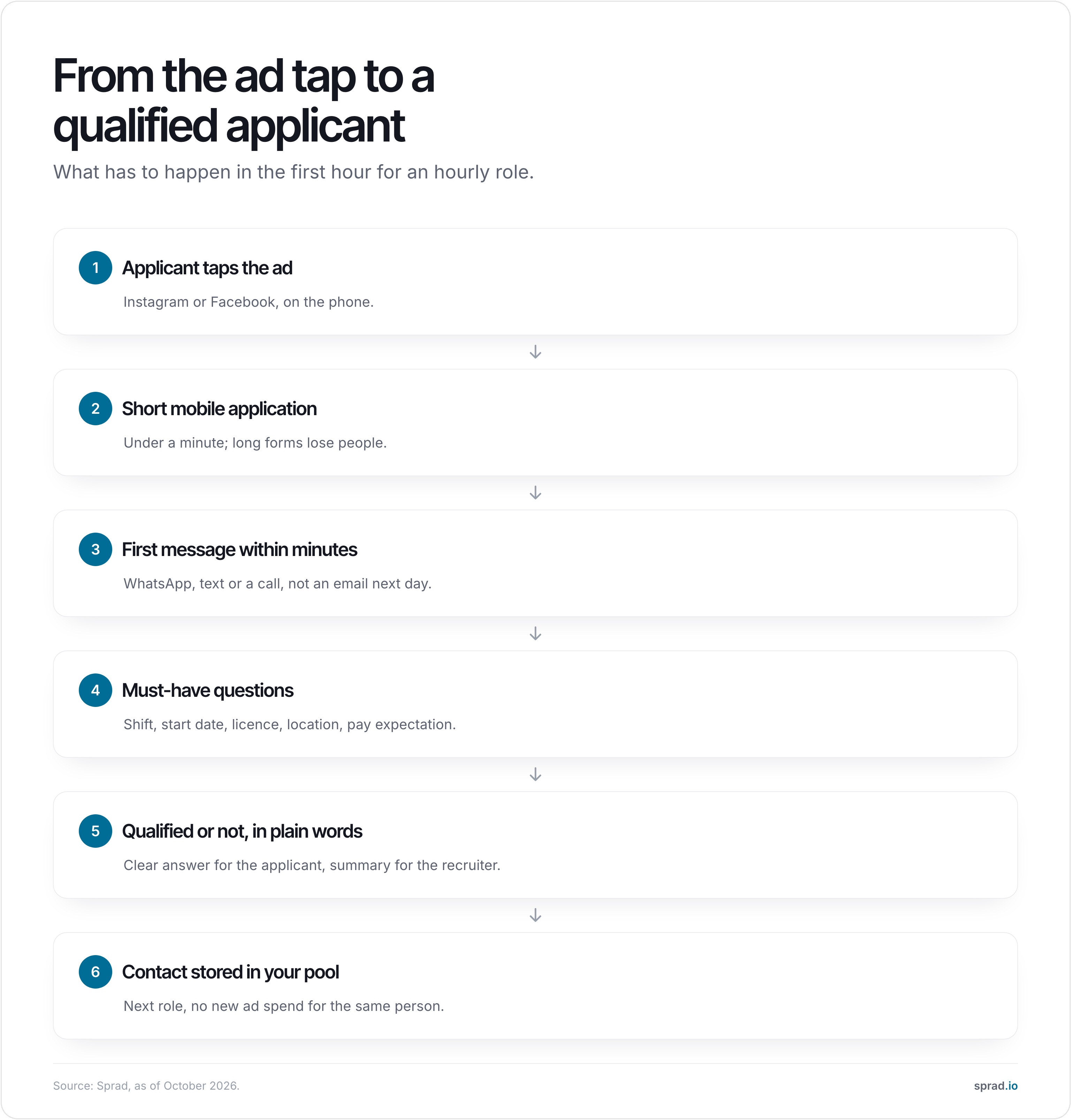
An AI Recruiter Agent covers the part between the click and the interview. In practice that means three things.
- Conversation instead of a form. The agent asks, listens and follows up in the applicant's words, in the channel they already use. For frontline workers that is WhatsApp, text or a phone call, not email.
- Screening against your criteria. You define the must-haves for the role (shift, start date, licence, location). The agent checks them and gives the recruiter a short summary instead of 200 unread applications.
- A pool that outlives the ad. Every applicant is kept as a contact. When the next role opens, you search your own pool before you pay for new reach.
Why speed matters is not a matter of taste. Fountain's 2025 Frontline Report says 57 % of frontline candidates cite slow hiring as their top frustration, and Fountain states that 60 % of applicants abandon applications that feel too long or are not mobile-optimized (vendor figures). Boostpoint's 2026 benchmark of 891 managed Meta campaigns found that what happens between the click and the finished application explained 70 % of the difference in cost per applicant, while the ad auction explained 18 %. The first conversation is a bigger lever than another round of bid tuning.
Side by side
| Question | Rule-based chatbot | Conversational AI assistant | AI Recruiter Agent |
|---|---|---|---|
| How it talks | Fixed script and buttons | Free text, scripted goals | Free text, voice and follow-ups |
| Channels | Career site, sometimes one messenger | Web chat, SMS, often WhatsApp | WhatsApp, phone, web |
| Where applicants come from | Your career site | Your career site and job boards | Social ads and your own pool |
| Who owns the contacts | Vendor tool or ATS | Vendor platform or ATS | Your own talent pool |
| Typical price | Low monthly fee or per hire; XOR about $500 per hire (Pin) | Quote only, enterprise budgets | From €0.49 per application (CV screening, chat interview, portal); voice interviews +€0.20 (Sprad price page, as of Oct 2026) |
What screening costs per hire: a worked example
Chatbot prices are quoted per month, per hire or per seat, so they are hard to compare. A fairer unit is the cost of screening per application and per hire. Here is one calculation with Sprad's published prices (sprad.io/pricing, as of 31 October 2026, net of VAT):
- Price: €0.49 per application covers CV screening, chat interviews and the candidate portal. If every fifth applicant also gets a voice interview, add €0.20, which makes €0.69 per application.
- Assumption: an employer with hourly roles receives 2,500 applications a year and makes 40 hires from them.
- Result: 2,500 × €0.69 = €1,725 a year, or about €43 of screening cost per hire. Without voice interviews it is €1,225 a year, about €31 per hire.
Two cautions. This covers screening only, not ad spend or recruiter time. And the €500 per hire that Pin reports for the chatbot XOR is not like-for-like, because the scope behind it is unknown. Use the calculation as a template: put your own application and hire numbers into the vendor's price model and compare the result per hire, not per month.
Established tools and what they cost
Almost no vendor publishes prices. The figures below come from Pin's 2026 comparison and other third-party reports and are unconfirmed; ask for a written quote.
| Tool | Type | Reported price (third party) |
|---|---|---|
| Pin | Sourcing with automated outreach | From $100 a month, free tier |
| XOR | Chatbot for hourly roles | About $500 per hire |
| Paradox (Olivia) | Conversational assistant | About $1,000 a month and up |
| Phenom | Talent suite with assistant | $50,000–200,000 a year |
| HireVue | Screening and video interviews | From $35,000 a month |
The spread is roughly 350 times between the cheapest and the most expensive offer, according to Pin. A price alone says little about fit; the more useful question is what you get per qualified applicant.
Three established options for hourly roles
Three names come up most often for hourly and frontline hiring. All three are built for the US market, none places your ads on Instagram or Facebook as a core product.
1. Paradox (Olivia)
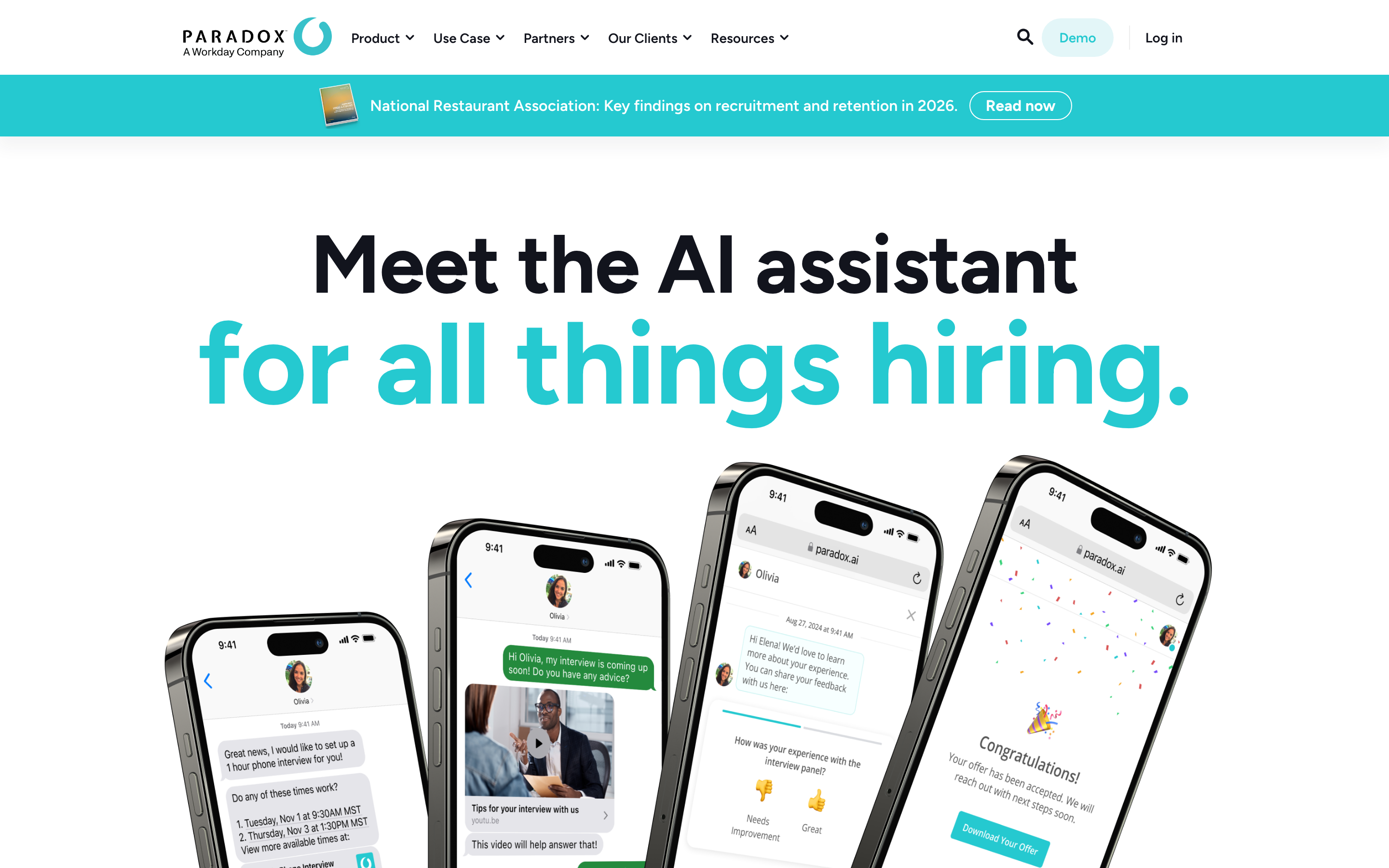
Olivia is the best-known conversational assistant for frontline hiring: applicants apply, answer knockout questions and schedule interviews in one chat. Workday announced the acquisition in August 2025 and completed it on 1 October 2025, for about $1 billion according to Pin. Customer claims such as Chipotle's "75 % faster hiring" were corroborated by CNBC in July 2025; other figures are vendor-reported.
2. Fountain

Fountain combines an AI recruiter with applicant tracking, onboarding and shift scheduling, and messages by SMS and WhatsApp. Its case studies include Bojangles, which reports cutting time to hire from 30 to 5.8 days; as a vendor claim, treat it as an upper-end example.
3. Workstream
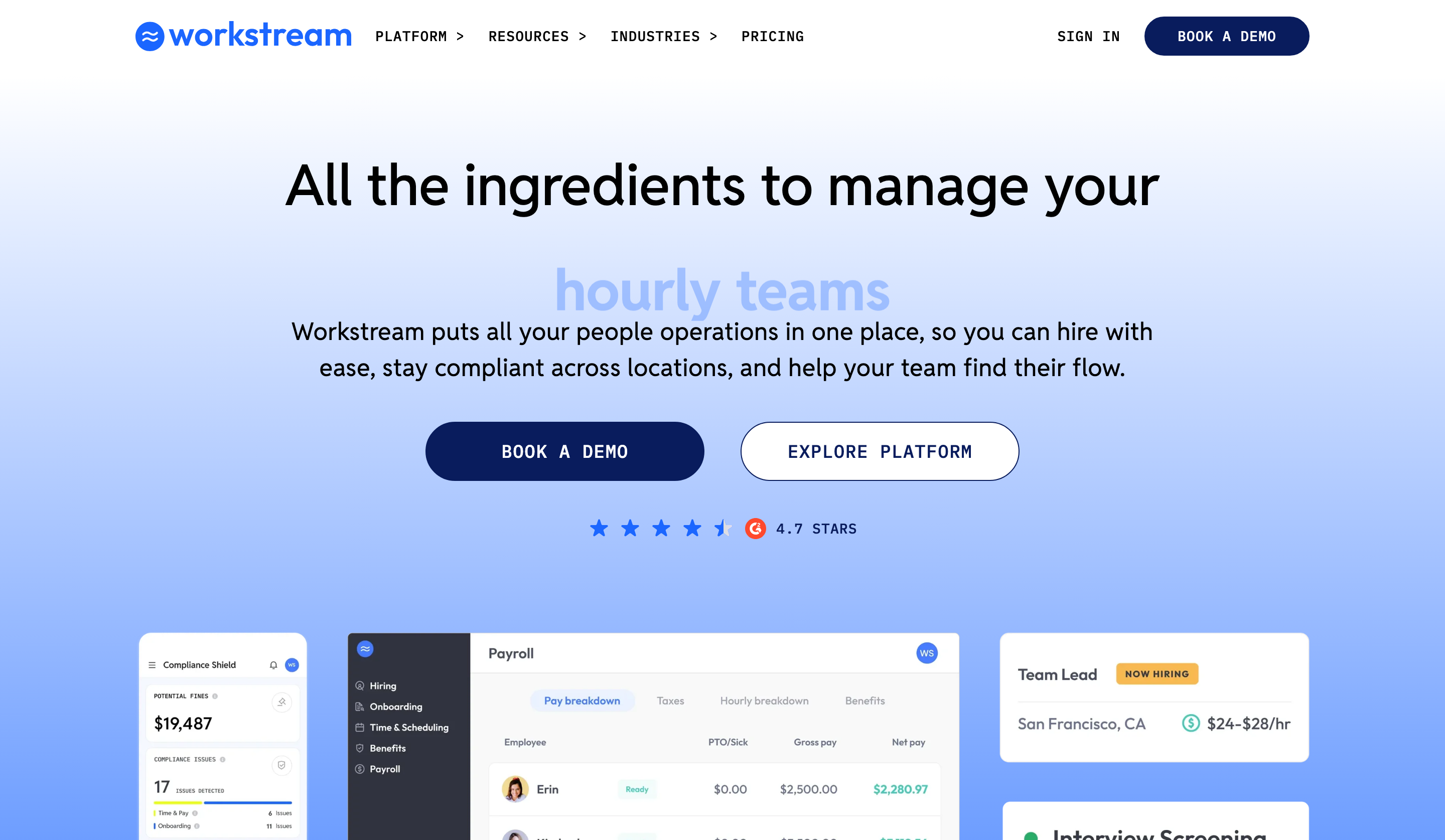
Workstream bundles hiring, onboarding and payroll for hourly workers, with text-to-apply and voice-AI screening. It is widely used in US restaurants, and fits best where one system for the whole employee lifecycle matters more than reach.
What the law requires in the EU
Not legal advice, but these points decide whether a chatbot can go live. The dates are the current ones as of 31 October 2026.
- Tell applicants it is an AI. Under Art. 50 of the EU AI Act, systems that talk to people must make clear that they are AI. This has applied since 2 August 2026.
- Recruiting AI is high-risk. Tools that filter applications or evaluate candidates fall under Annex III of the same regulation. The high-risk duties (risk management, human oversight, logging) apply from 2 December 2027, after the Digital Omnibus Regulation (EU) 2026/1744 moved the date. A pure FAQ bot is usually outside this scope; a bot that scores or ranks applicants is inside it.
- No emotion recognition. Inferring emotions of applicants from voice or video has been banned at the workplace since 2 February 2025 (European Commission, AI Act overview). A voice interview may assess answers, not feelings.
- A person decides. Art. 22 GDPR limits decisions based solely on automated processing. The Court of Justice read this broadly in the SCHUFA judgment (C-634/21, December 2023): even a score that a human merely follows can count as the decision. Do not auto-reject on a bot's score.
- Inform and delete. Applicants must be told what is processed and why (Art. 13/14 GDPR), and data has to be deleted or consented to when the purpose ends.
Typical mistakes and what to measure
These are the mistakes we see most often when an employer switches on a bot for hourly roles:
- Too many questions. Every extra field costs applicants. Keep to the three or four criteria that really exclude someone (permit, licence, shift, start date) and ask the rest in the conversation.
- Knockout questions that exclude by accident. Age, gender, nationality or "native speaker" have no place in a filter. Check every must-have for a job-related reason.
- No handover. If a free-text answer does not fit, the applicant needs a person within a working day, not a dead end.
- Automatic rejection. It is the riskiest setting legally (see above) and loses people you may need next month.
- Only the language of the career site. Test the bot in the language your applicants actually write.
Measure five numbers per role from week one: time to first reply, completion rate of the application, share who meet the must-haves, show-up rate at the interview and cost per qualified applicant. If the first two are poor, no screening logic downstream will fix it.
How to choose: five questions
- Where do your applicants come from? From your career site, a chatbot on that page is enough. From Instagram and Facebook ads, the conversation has to continue where they are, on their phone.
- How fast is the first reply? Ask for the median time from application to first message. Minutes beat hours.
- Who writes the screening questions? You should control the must-haves per role, not accept a generic script.
- Who keeps the contacts? Ask whether applicants stay in your own pool if you cancel, and in which format you can export them.
- What is the price per qualified applicant? Not per seat, not per click. A tool that screens 500 applicants but delivers 5 interviews costs more than its price list says.
If you recruit in logistics or hospitality, our guide on why phone and WhatsApp beat email for frontline recruiting shows the channel side in detail, and blue-collar screening versus white-collar screening explains why the same questions do not work for both groups.
Where Sprad fits
For the screening and interview part Sprad works as follows. CV screening reads every application and scores it with a reason per criterion and the quote behind it; nothing is rejected automatically, a recruiter decides. Interviews run as chat, voice or video in many languages, and applicants can be invited and reminded on WhatsApp. Pricing is the per-application model above, or credits for the whole company. Limits to know: there is no SMS channel (WhatsApp, phone and web instead), and in the US text chat currently works best; other setups are possible on request.
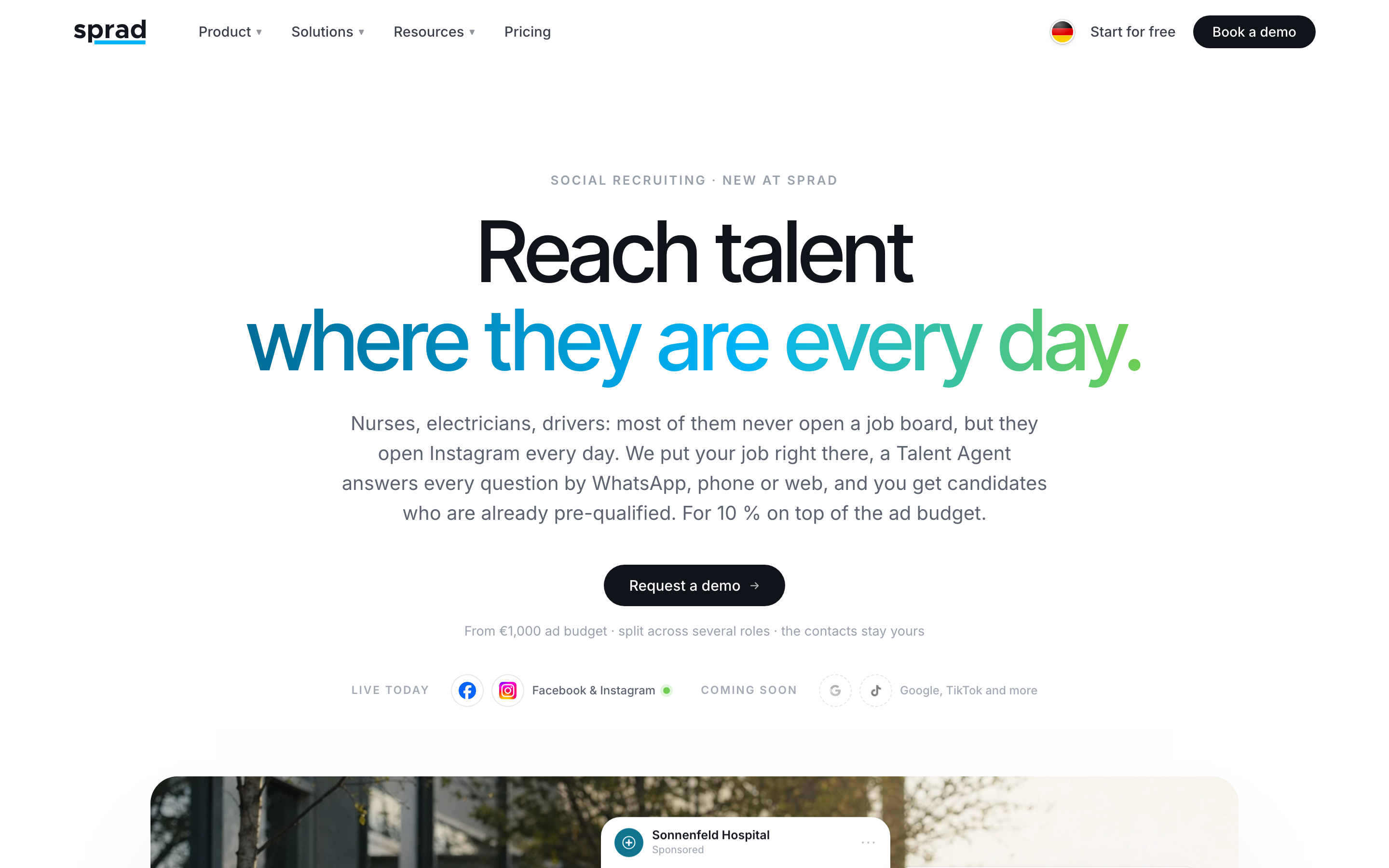
Sprad Social Recruiting runs job ads on Instagram and Facebook, where nurses, tradespeople, drivers and other frontline workers spend time every day. An AI Recruiter Agent pre-screens every applicant via WhatsApp, phone or web. Every applicant lands in the employer's own talent pool, so the relationships stay with the employer instead of a platform. Pricing is from €1,000 per month, which can be split across roles; Google and TikTok are to follow. See the Sprad Social Recruiting page for details and the Talent Network for how the pool works.
FAQ
What is a recruitment chatbot?
A recruitment chatbot is software that talks to applicants in a chat window or messenger. It answers common questions, asks screening questions and schedules interviews, usually following a pre-defined script.
What is the difference between a chatbot and an AI recruiter?
A chatbot matches keywords to prepared answers. An AI recruiter or Recruiter Agent understands free-form language, adapts the conversation and completes tasks such as screening and follow-up. Vendors use the terms loosely, so check the features, not the label.
Do chatbots work for hourly and frontline hiring?
Yes, if they reply within minutes on a channel the candidate uses, usually text or WhatsApp, and keep the application short. On a long career-site form they help little, because 60 % of applicants abandon applications that feel too long, according to Fountain.
How much does a recruitment chatbot cost?
From about $500 per hire for an hourly-role chatbot to $35,000 a month for enterprise screening, according to Pin's 2026 comparison. Most vendors quote on request, so get a written offer and ask what the price is per qualified applicant.
Can a chatbot replace recruiters?
No. It takes over repetitive first steps such as questions, knockout criteria and scheduling. Judging fit, convincing candidates and making the offer stay with people. Gartner found in October 2025 that 88 % of HR leaders saw no significant value from AI tools yet, as cited by Pin, so measure results on your own roles.
Who owns the applicant data?
It depends on the provider. With many platforms the data stays in the vendor's system. Ask whether applicants land in your own talent pool and whether you can take them with you.
Do I have to tell applicants they are talking to an AI?
Yes. Art. 50 of the EU AI Act requires systems that interact with people to disclose that they are AI; it has applied since 2 August 2026. Say it in the first message.
Is AI screening of applications allowed in the EU?
Yes, but recruiting AI counts as high-risk under Annex III of the AI Act, with the extra duties applying from 2 December 2027 (Regulation (EU) 2026/1744). Art. 22 GDPR also means a person should make the final decision.
What is the difference between a chatbot and an AI voice interview?
A chatbot asks fixed questions in text. A voice interview lets the applicant answer aloud in their own words, which helps people who write little or apply from a phone. The agent assesses the content of the answers against your criteria; it should not judge emotions, which is banned at work in the EU.
How much does AI screening cost per application?
Sprad charges €0.49 per application for CV screening, chat interviews and the candidate portal, and €0.69 if every fifth applicant also gets a voice interview (as of October 2026, net of VAT). Many other vendors quote only on request.
Jürgen Ulbrich
Jürgen Ulbrich has more than a decade of experience in developing and leading high-performing teams and companies. As an expert in employee referral programs as well as feedback and performance processes, Jürgen has helped over 100 organizations optimize their talent acquisition and development strategies.