Run social media job ads yourself if you hire for one or two role families, someone owns the topic for about 10 to 20 hours a month and applicants get an answer within hours. Hire an agency if you fill many roles at once and have no marketing capacity, and accept a fee of roughly €1,000 to €3,500 a month on top of the ad budget. A third route sits in between: software that runs the ads and pre-screens applicants, so you neither build everything yourself nor pay a retainer. As of October 2026.
The decision in one question: where does your time go?
Social media recruiting means paid job ads on Facebook and Instagram, where frontline workers spend time every day. The ads themselves are not the hard part. The work around them is: writing hooks, producing photos, keeping the application route short, reading the numbers and, above all, answering applicants fast. Whether you do that yourself or pay someone is mostly a question of capacity and volume, not of talent.
The ranking guides on this topic mostly tell you "it depends" and list pros and cons. What they rarely give you are numbers for hours, fees and a worked example. This article adds both, plus a rule of thumb you can apply in five minutes.

What running the ads yourself really involves
For one role family, our planning estimate is about 10 to 20 hours a month once the campaign is set up, plus roughly 15 hours in the first month for set-up. These are estimates from our own planning, not a measured benchmark. The hours go into four areas:
- Creative: three ad variants with different first lines, real photos from your workplace, a short text. Only about the first 125 characters show in the feed.
- Set-up and rules: Facebook Page, ad account, consent for the pixel and lead forms, and the Employment special ad category.
- Replies: someone has to answer every applicant, ideally by phone or WhatsApp within hours.
- Reading the data: cost per applicant, the share of applicants who fit and cost per interview.
The Employment category is where most first-timers get surprised. Per Meta Business Help, ads for jobs cannot target by age, gender or ZIP code, location works as a radius, and the scope depends on the market, so check it in Ads Manager. The practical effect: the ad text and the pre-screening do the filtering, not the targeting. Our 30-day plan for social media recruiting walks through the steps week by week.
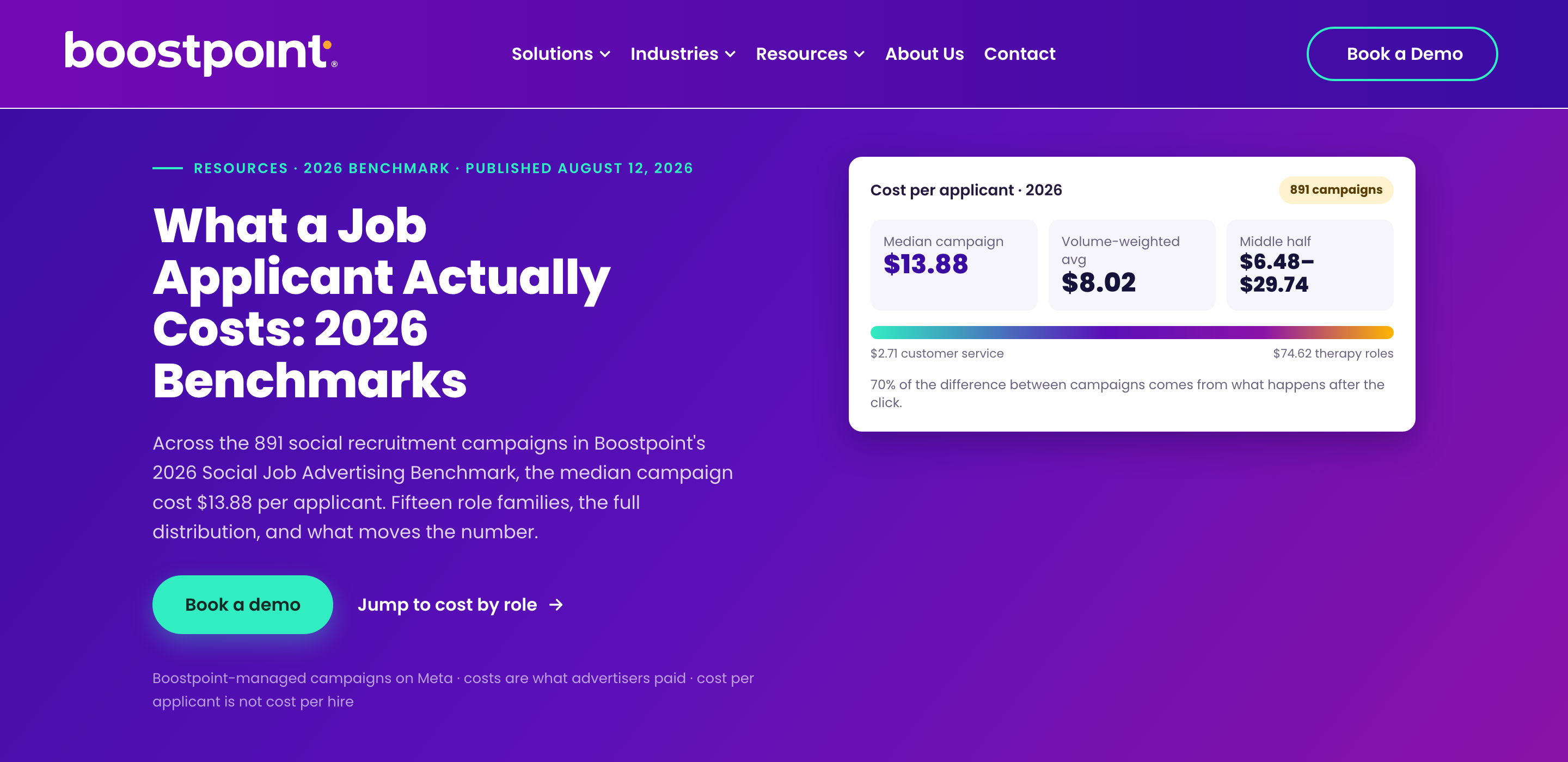
On cost, a US benchmark gives a reference point: Boostpoint analysed 891 Meta campaigns in 2026 and found a median of $13.88 per applicant, from $2.71 for customer service to $74.62 for therapy roles. It also tied 70 % of the cost differences to what happens after the click, mainly whether people finish the form. Both numbers are US data, so use them as orientation, not as a promise for your region.
What an agency does for you, and where it falls short
An agency takes over creative, set-up and campaign management and brings experience from earlier campaigns. That helps when you hire for many roles in parallel, when you have no marketing capacity or when ads have failed twice before. The market ranges we could verify: retainers of roughly €1,000 to €3,500 a month, set-up fees of €1,000 to €3,000 and an ad budget of often €500 to €1,500 per role and month on top. One provider publishes €5,000 per position.
The weak points are the same ones in almost every guide. The fee applies with or without applicants. The ad account and the contacts often stay with the agency. And an agency can run the ads, but it usually does not answer your applicants, so the hardest step stays with you. If you go this way, use our ten questions for vetting an agency before you sign, and compare the pricing models in our agency pricing breakdown.
A worked example: one role family over three months
Take a logistics company hiring drivers, with a €1,000 monthly ad budget. The figures below are illustrative assumptions, not offers:
| Route | Monthly cost | Three months | Who answers applicants |
|---|---|---|---|
| In-house | €1,000 ad budget + about 15 hours of your own time | €3,000 + about 45 hours | You |
| Agency (market example) | €2,000 fee + €1,000 ad budget | €9,000, plus set-up fee if charged | Usually you |
| Software with pre-screening (Sprad) | €1,000 ad budget + 10 % = €1,100 | €3,300 | An AI talent agent pre-screens via WhatsApp, phone or web |
The point is not that one line wins. In-house is cheapest in cash if your time is free, the agency is the only one that buys expertise, and the software route is the one where the pool of applicants stays yours. With the US median of $13.88 per applicant, a $1,000 budget would buy roughly 70 applicants; what share of them fits depends on your ad, your pay and your reply time.
How to decide: a five-minute checklist
| Question | If yes | If no |
|---|---|---|
| Do you hire for fewer than three role families? | In-house is realistic | Agency or software |
| Does someone own the topic for 10–20 hours a month? | In-house works | Agency or software |
| Can you answer applicants within hours? | Any route works | Fix this first, or pick pre-screening |
| Do you want applicants to stay in your own pool? | In-house or software | Agency is fine |
| Do you have a marketing person with ad experience? | In-house | Agency or software |
Two or more answers in the "agency or software" column are a signal that in-house will stall after the first month. Most teams that fail with in-house do not fail on the ads; they fail on the replies.
The hybrid: in-house control, outside help where it hurts
You do not have to choose one extreme. A common setup is to keep the ad account and the applicant data in your name, buy creative or set-up once, and automate the first reply. That keeps the learnings with you and avoids a long retainer. Whatever you choose, store every applicant in a talent pool with source, role and qualification, so that the second role does not start from zero.
The Sprad way: ads and pre-screening in one
Sprad Social Recruiting is built for teams that want neither a retainer nor a pile of manual work. It runs your job ads on Instagram and Facebook, where nurses, tradespeople, drivers and other frontline workers spend time every day. An AI talent agent pre-screens every applicant via WhatsApp, phone or web, and every applicant lands in your own talent pool, so the relationships stay with you instead of a platform. Pricing is ad spend plus 10 %, from a €1,000 budget that can be split across roles, with a recommended runtime of three months. There is no guarantee of applicants or hires, and the budget recommendations are guidelines. See the Sprad Social Recruiting page for details, and our Talent Base for how the pool works.
FAQ
Can I run social media job ads myself?
Yes. For one or two role families it is realistic with about 10 to 20 hours a month, a short application route and fast replies. Plan at least about €1,000 of ad budget per role group over three months to get usable data.
When is an agency worth it?
When you hire for many roles at once, have no marketing capacity and need creative and set-up done quickly. Negotiate a short contract, an ad account in your name and a written definition of a qualified applicant.
What does an agency cost compared to doing it yourself?
Market ranges are roughly €1,000 to €3,500 a month plus ad budget, sometimes with a set-up fee. In-house costs only the ad budget and your own time, which we estimate at 10 to 20 hours a month per role family.
Which is faster?
An agency or software can launch within days to a few weeks. In-house takes about 30 days from first set-up to the first reliable numbers, because you build the creative, form and consent yourself.
Is there a middle way?
Yes. Software that runs the ads and pre-screens applicants sits between in-house and agency. With Sprad you pay ad spend plus 10 %, from a €1,000 budget, and applicants land in your own talent pool.
What is the biggest mistake with in-house?
Slow replies. Applicants from frontline roles go cold within hours, so the question is not only who builds the ads, but who answers.
Jürgen Ulbrich
Jürgen Ulbrich has more than a decade of experience in developing and leading high-performing teams and companies. As an expert in employee referral programs as well as feedback and performance processes, Jürgen has helped over 100 organizations optimize their talent acquisition and development strategies.