A credible social media recruiting agency shows results from your industry, lets you speak to a reference client, runs your ad budget on an account you own, reports qualified applicants instead of clicks and does not lock you in for 12 to 24 months. Ten questions in the first call separate serious providers from sales talk. Promises such as "hires in 30 days" are the clearest warning sign, because nobody can guarantee hires without knowing your role, region and pay. As of October 2026.
Why vetting matters more here than for other agencies
Social media recruiting means paid job ads on Facebook and Instagram. The market is young, most providers publish no prices and anyone can call themselves a recruiting agency. At the same time the money is real: besides the agency fee you pay an ad budget that is gone the moment it is spent. In our review of agency guides and the prices we could verify, fees ranged from about €1,000 to €3,500 a month plus ad budget, and one provider charges €5,000 per position. A bad choice therefore costs not only the fee but also months of hiring time.
The guides that rank for this topic mostly agree on the basics: ask for references, expect transparency, avoid long contracts. What they rarely give you is a list you can take into the call. That is what the ten questions below are for. For the money side, see our breakdown of agency pricing models.
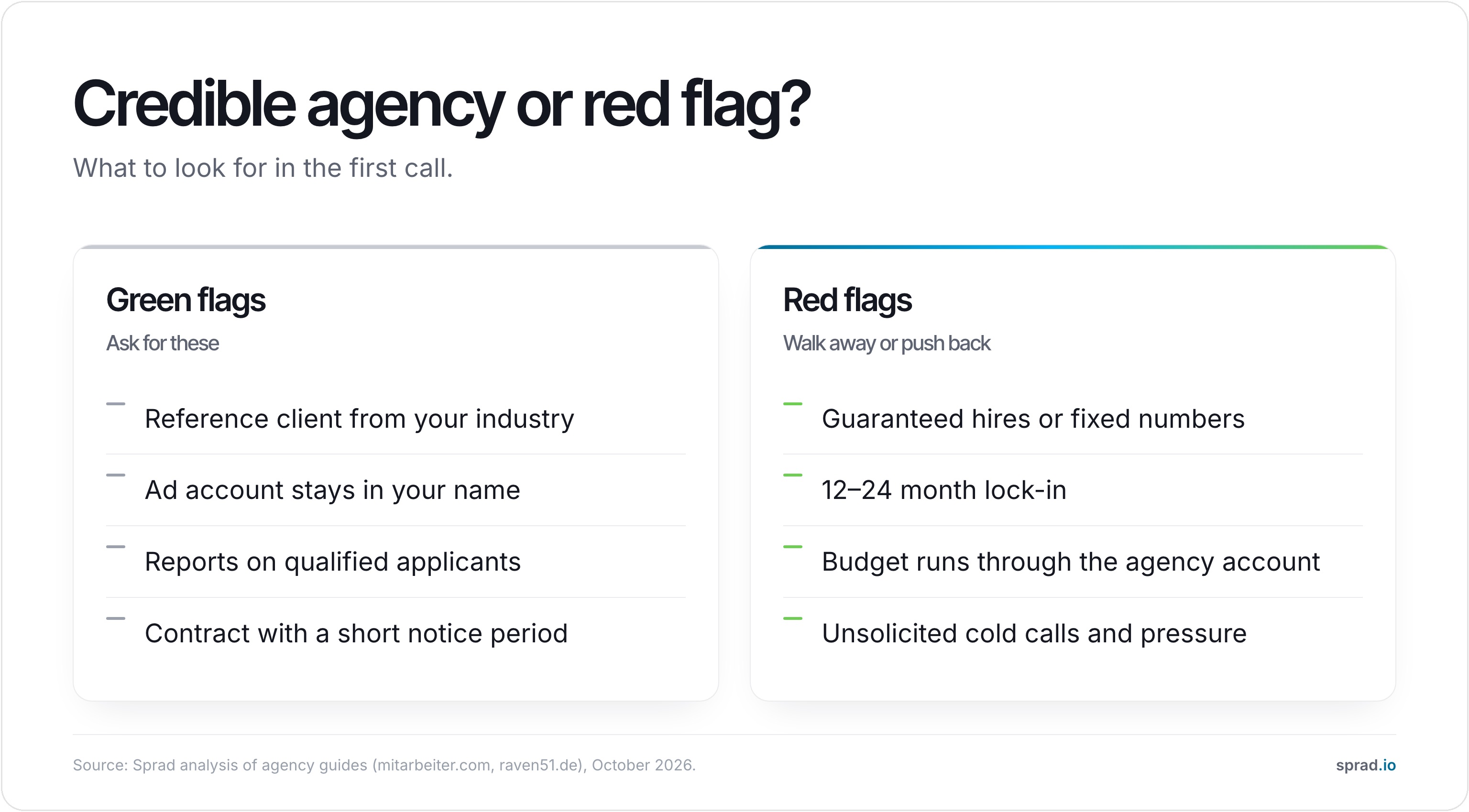
The 10 questions to ask before you sign
1. Which clients in my industry have you served, and can I talk to one?
Nurses, drivers and electricians respond to different ads than software developers. Ask for two or three cases from your field with the role, the region and the result, and ask to speak to a client yourself. A serious agency arranges that without detours. If it only sends a PDF with logos, treat it as marketing, not proof.
2. How do you define a "qualified applicant"?
This is the most important question, because it decides what you pay for. A click, a filled-in form and an applicant who meets your must-haves are three very different things. Ask for the agency's definition in writing and who checks it. Agencies that report only reach and clicks leave you to find out later that the applicants do not fit.
3. Who owns the ad account and the applicant data?
The ad budget should run on an ad account in your name, so you see every euro and keep the account, the audiences and the learnings if you leave. The same applies to applicant data: where do the contacts end up, and can you export them? Guides on agency red flags list budgets that run through the agency's own account as a warning sign for good reason.
4. What exactly does the fee cover, and what costs extra?
Ask for a line-by-line list: strategy, ad creative, video or photo production, landing page, campaign management, reporting, applicant handling. Then ask what is not included. Typical extras are set-up fees, production, a separate landing page and changes after launch.
5. Who carries the risk if there are no applicants?
Flat monthly fees are charged with or without applicants. Pay-per-applicant and success-based models move part of the risk to the agency, but ask what counts as a billable applicant. A model is fair when the definition from question 2 and the price belong together.
6. How long is the contract, and how do I get out?
Social media campaigns need a few weeks to produce data, so three months of runtime is a sensible recommendation. Twelve or twenty-four months are not. Ask for the notice period, what happens to the budget already paid and whether you can pause.
7. What will you not promise me?
A good agency can name the limits. Hires depend on your pay, your location, your reaction time and the labour market. If the answer is "everything is possible" or "X applications or we work for free", be careful. A guarantee without knowing your role is a sales line, not a calculation.
8. Who answers my applicants, and how fast?
Applications from frontline roles go cold within hours. Ask who contacts the applicants, over which channel and in what time. WhatsApp or a phone call usually works better than email for these roles, see our article on why frontline recruiting runs on phone and WhatsApp. If the agency hands you a list of leads and stops there, the hardest part is still yours.
9. How do you handle data protection and the Meta rules?
Meta puts job ads in the "Employment" special ad category. There you cannot target by age, gender or ZIP code, and location works as a radius. The scope depends on the market, so check it in Ads Manager. An agency that does not mention this limit has either not run many job campaigns or is hiding it. Also ask about consent for the pixel and lead forms, a data processing agreement and storage periods. This is not legal advice; clear it with your data protection officer.
10. What do reports look like, and how often do I get them?
Ask for a sample report. It should show spend, cost per applicant, the share of qualified applicants and, if possible, interviews and hires, at least monthly. A report that ends at impressions and clicks tells you little about your hiring.
Red flags: what should make you stop

Guides on this topic repeat the same signals, and they match what we see in the market:
- Unsolicited cold calls and pressure to decide the same day.
- Guarantees such as "hires in 30 days" or fixed application numbers.
- Long lock-ins of 12 to 24 months.
- Budget through the agency account without your own access.
- No named people and no references you can call.
- Reports without a definition of what counts as qualified.
Be careful with reviews as well. A profile on a neutral platform helps, but check how many reviews stand behind the rating, and whether applicant reviews and employer reviews are mixed. A 3.5-star rating from three reviews, as in the example above, is a hint, not a verdict.
Score the answers: a simple traffic-light table
| Question | Good answer | Warning sign |
|---|---|---|
| Industry experience | Two or three cases, reference call possible | Only logos, no contact |
| Qualified applicant | Written definition, you can check it | "Leads" and clicks only |
| Ownership | Ad account and data in your name | Budget on the agency account |
| Fee | Line-by-line list, extras named | "All inclusive" without detail |
| Risk | Model matches the definition of qualified | Fee due even without applicants, no explanation |
| Contract | About three months, short notice | 12–24 months |
| Promises | Names the limits openly | Guaranteed hires |
| Applicant handling | Clear owner, reply within hours | You get a lead list |
| Compliance | Knows the Employment category, asks for consent | Never heard of it |
| Reporting | Monthly, down to qualified applicants | Reach and clicks only |
Count the warning signs. One or two can be talked through. Four or more are a reason to look elsewhere.
What if I do not want an agency at all?
There are three routes: run the ads yourself, hire an agency, or use software that handles ads and pre-screening for you. Which one fits depends on how many roles you hire for and how much marketing capacity you have. We compare them in in-house or agency: which fits which team. If you want to start yourself, our 30-day plan for social media recruiting shows the steps.
The Sprad way: your own pool instead of rented reach
Sprad Social Recruiting runs your job ads on Instagram and Facebook, where nurses, tradespeople, drivers and other frontline workers spend time every day. An AI Recruiter Agent pre-screens every applicant via WhatsApp, phone or web, and every applicant lands in your own talent pool, so the contacts stay with you instead of a platform. Pricing is from €1,000 per month, which can be split across roles, with a recommended runtime of three months. There is no guarantee of applicants or hires, and the budget recommendations are guidelines. Look at the details on the Sprad Social Recruiting page and put the same ten questions to us.
More on the channel in our social recruiting hub. Looking for a partner in Switzerland? Compare the social media recruiting agencies in Switzerland.
FAQ
How do I recognise a credible social recruiting agency?
By proof and transparency: references from your industry, a written definition of qualified applicants, an ad account in your name, a short contract and reports that go beyond clicks. Promises of guaranteed hires are the clearest warning.
What are typical red flags?
Cold calls, pressure to sign quickly, 12 to 24 month contracts, budget through the agency account, inflated statistics and no reference clients you can call.
How long should a contract run?
Three months is a sensible runtime because the first month mostly teaches you what works. Be careful with anything over six months, and ask for a notice period and a pause option.
What does a social recruiting agency cost?
Market ranges we found are roughly €1,000 to €3,500 a month plus ad budget, plus one published price of €5,000 per position. Success-based models in the adjacent placement market charge 14 to 22 % of the annual salary. Prices change, so ask for a written offer.
Can I check an agency's reviews?
Yes. Use neutral platforms such as OMR Reviews, G2 or Capterra, look at the number of reviews and the date, and separate applicant reviews from employer reviews. Few reviews are a hint to ask for a reference call.
Is a pay-per-applicant model always better?
Not automatically. It moves risk to the agency, but only works if "applicant" is defined as someone who meets your must-haves. Otherwise you pay per form submission.
Jürgen Ulbrich
Jürgen Ulbrich has more than a decade of experience in developing and leading high-performing teams and companies. As an expert in employee referral programs as well as feedback and performance processes, Jürgen has helped over 100 organizations optimize their talent acquisition and development strategies.