The best way to hire blue-collar workers in Germany in 2026 is to meet them where they spend time every day: on their phones, in Instagram and Facebook, not on career portals. State pay, shift pattern and location in the ad and pre-screen applicants via WhatsApp, and you fill roles faster than with a classic job posting. The need is large: 6.85 million employees subject to social insurance work in production and manufacturing alone, and the Federal Employment Agency lists 157 shortage occupations. As of October 2026.
How big is the need for blue-collar workers?
“Blue-collar” covers work in production, trades, construction, warehousing, logistics, cleaning and hospitality: work at the machine, on the site or at the vehicle rather than at a desk. According to Federal Employment Agency statistics (as of 31 December 2025), 6,850,263 of 34,985,555 employees subject to social insurance work in raw materials, production and manufacturing. Construction accounts for about 2.07 million and transport and logistics for about 4.6 million.

The shortage is uneven. The Federal Employment Agency’s shortage occupation analysis 2025 lists 157 shortage occupations (2024: 163, 2023: 183). Construction and the trades are hit hard, as are cooks and professional drivers. The KOFA research centre counts almost 100,000 vacancies in the skilled trades in 2025 that cannot be filled on paper, with 59 of 115 trades short of workers. The overall gap has shrunk, but it has not gone away.
For single roles, see our guides to hiring warehouse workers and hiring truck drivers. This guide covers what all blue-collar roles have in common.
Where do blue-collar candidates spend their time?
Blue-collar applicants rarely have an up-to-date CV and do not read career portals. They look for work on the way, on a break or after the shift, phone in hand. What that means for your search:
- Feed instead of portal: ads on Instagram and Facebook also reach people who are not looking right now but would move for a better offer.
- No CV: a short application on the phone, three taps, no attachments.
- Personal contacts stay strong: employee referrals are the most important route in small firms and complement every ad. See how to find employees: 12 ways.
- Answer the same day: whoever calls back first gets the applicant.
Mind Meta’s “Employment” special ad category: age, gender and postcode cannot be chosen as targeting, and location only as a radius (from about 25 kilometres, 15 miles). Check the current rules in Ads Manager. Why phone and WhatsApp beat email for blue-collar applicants is explained in frontline recruiting by phone and WhatsApp.
Sample ad for blue-collar roles
This is an invented template so you can see the structure. Replace pay, location and benefits with your real values:
Machine operator (m/f/d), early shift, Stuttgart area
€2,900 gross plus shift allowances, permanent contract from now on, two weeks of on-the-job training, 30 days of holiday. No CV needed: tap “Apply now”, answer five questions on WhatsApp and we will get back to you today.
The template starts with what applicants want to know: pay, shift, place and whether they get proper training. The application path is as small as possible. In shift roles, what decides is often not qualification but whether working hours and commute fit.
Pre-screening: what to check first for each role
The more applications an ad brings, the more the first selection matters. An AI talent agent can ask the must-have criteria around the clock via WhatsApp, phone or web, so your team only talks to people who fit. The must-haves differ by role:
| Role | First must-have question (examples) | Second question |
|---|---|---|
| Production, machine operator | Experience with a comparable machine or line | Shift availability (early, late, night) |
| Warehouse and logistics | Valid forklift licence | Weekends and shifts possible |
| Drivers | Licence category, Code 95, driver card | Local, long-haul or distribution |
| Construction and trades | Journeyman certificate or proven experience | Category B licence, travel radius |
| Cleaning and facility services | Sites within reach | Working-hours window (early morning, evening) |
| Kitchen and service | Experience in a comparable business | Food-hygiene instruction under the German Infection Protection Act, availability |
The table shows examples, not legal requirements. You set your own must-haves. Five questions are usually enough for any role:
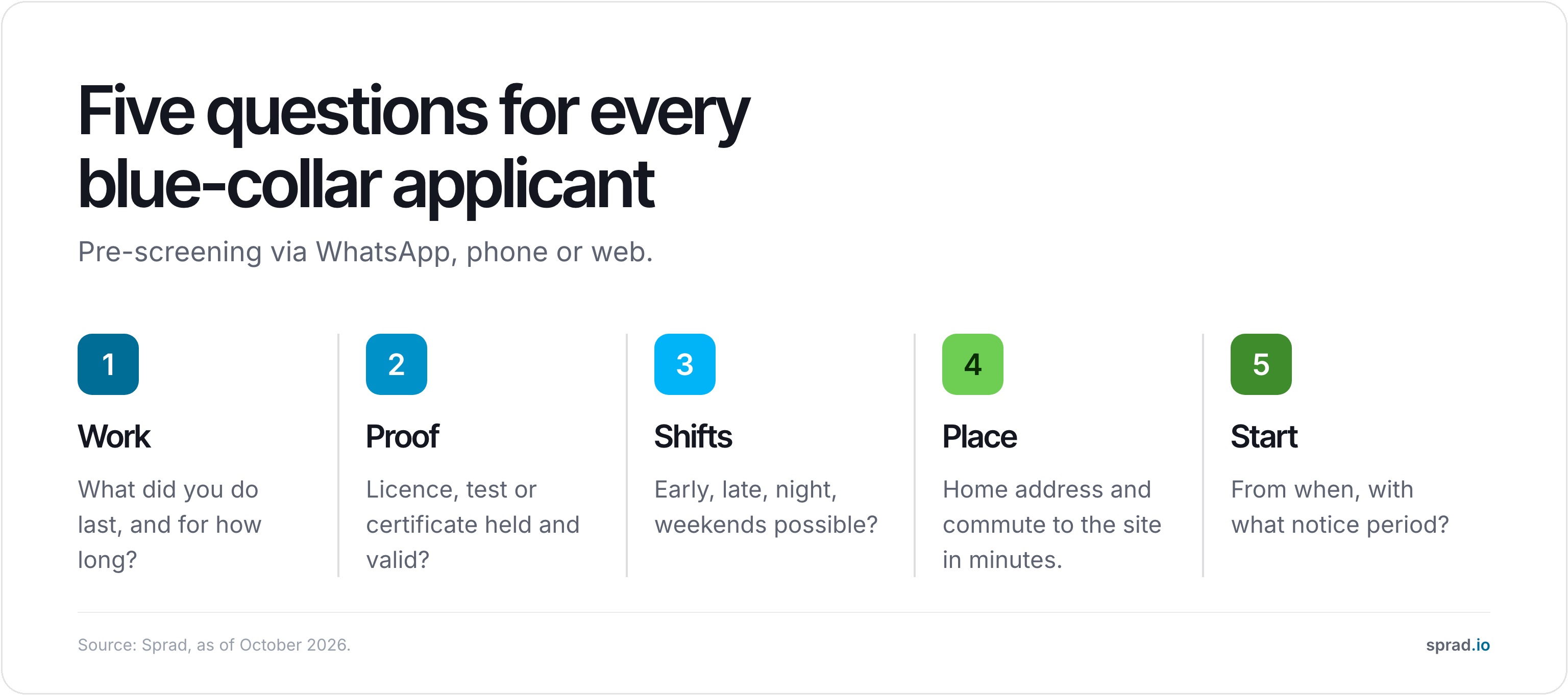
- Work: what did you do last, and for how long?
- Proof: licence, test or certificate held and valid?
- Shifts: early, late, night, weekends possible?
- Place: home address and commute to the site in minutes.
- Start: from when, with what notice period?
Why screening blue-collar applicants differs from office roles is covered in screening blue-collar candidates.
Budget example: what does it cost to win blue-collar workers?
Social media recruiting pays for reach, not for the hire. The calculation shows orders of magnitude, it is neither a forecast nor a guarantee of applicants.
| Model | Calculation | Cost |
|---|---|---|
| Ad budget plus 10 % (Sprad), 1 role | €1,000 budget over 3 months | €1,100 total |
| Ad budget plus 10 %, 5 roles | €5,000 budget, splittable | €5,500 total |
| Social agency with flat fee | €5,000 per position according to the provider | €5,000 per role |
| Commission model | 14 to 22 % of annual salary, assumed €34,800 (€2,900 × 12) | €4,872 to €7,656 per hire |
For a sense of reach: the Boostpoint Benchmark 2026 reports a US median of $13.88 per application (891 campaigns), roughly 70 applications per $1,000. As a thought experiment: if only about one in three of 70 applicants meets your must-haves (assumption), about 23 remain for a conversation, and your team talks only to them. These are US figures and assumptions and may differ in Germany. Agency and commission prices come from the providers, as of October 2026.
Common mistakes when hiring blue-collar workers
- No pay in the ad: blue-collar applicants compare at once and scroll on.
- Asking for a CV: nobody writes a cover letter on a phone.
- Answering too slowly: after two days the applicant has said yes elsewhere.
- Relying on one channel: an ad plus a referral bonus carries further than either alone.
- Losing contacts: someone who does not fit today may fit in six months. Your own pool keeps the contact.
Four regions, four approaches
- Ruhr area: dense industry and logistics, many employers hiring at once, shift pattern and commute decide.
- Stuttgart region: metalworking, machinery and suppliers, high living costs, so pay and allowances belong in the ad.
- Hamburg: port and distribution, night shifts, home-every-night routes and training set you apart.
- Leipzig and Halle: large logistics sites, many shift roles, short distances between sites.
The regions are examples, not measurements. Name location and shift in the ad, not just the city.
Hiring blue-collar workers with Sprad
Sprad Social Recruiting runs job ads on Instagram and Facebook, where nurses, tradespeople, drivers and other frontline workers spend time every day. An AI talent agent pre-screens every applicant via WhatsApp, phone or web. Every applicant lands in the employer’s own talent pool, so the relationships stay with the employer instead of a platform. Pricing is ad spend plus 10 %, from a €1,000 budget that can be split across roles, with three months recommended.
More on the product at Sprad Social Recruiting. How the pool works is explained in Talent Base, and the sectors are covered under manufacturing and trades.
FAQ
How do I find blue-collar workers?
With paid ads on Instagram and Facebook that state pay, shift and location, a short application on the phone, employee referrals and an answer the same day.
What does “blue-collar” mean?
Blue-collar workers do practical, physical work in production, trades, construction, warehousing, logistics, cleaning or hospitality rather than office work. The counterpart is white-collar staff in commercial and administrative roles.
What does it cost to find blue-collar workers?
With ad spend plus 10 %, a €1,000 budget costs €1,100 in total. Agencies quote €5,000 per position according to the provider, and commission models 14 to 22 % of annual salary.
Which channels work for blue-collar roles?
Employee referrals, Instagram and Facebook ads, the Federal Employment Agency job board and regional networks. Which comes first depends on role, region and time.
How many roles can one budget cover?
With Sprad the budget can be split across several roles. There is no flat fee per role, and you can start from a €1,000 budget.
Can I contact applicants on WhatsApp?
Yes, if the applicant has agreed to that route, for example by tapping “Apply now” with a notice. Details in contacting candidates on WhatsApp. This is not legal advice.
Jürgen Ulbrich
Jürgen Ulbrich has more than a decade of experience in developing and leading high-performing teams and companies. As an expert in employee referral programs as well as feedback and performance processes, Jürgen has helped over 100 organizations optimize their talent acquisition and development strategies.