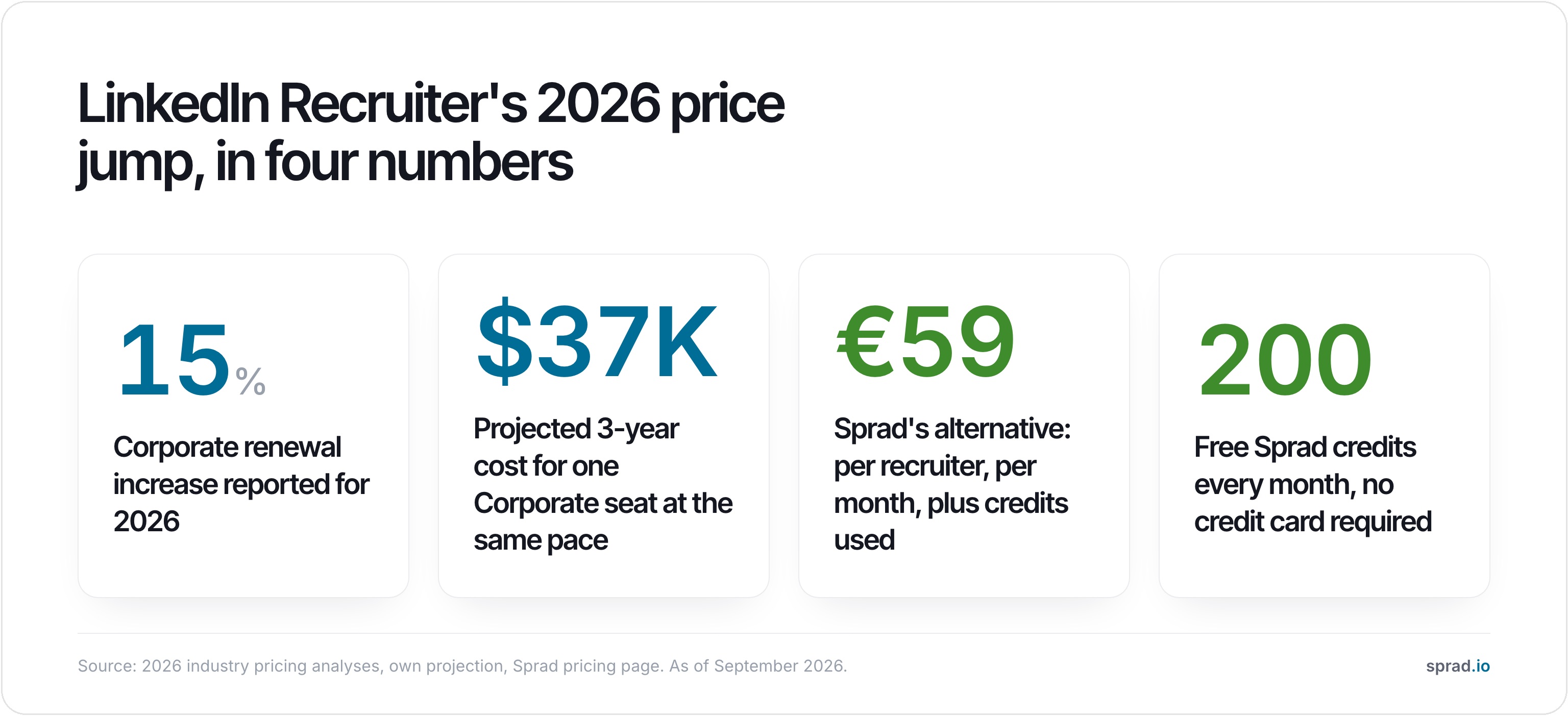
LinkedIn Recruiter Corporate renewals have risen roughly 15% in 2026, pushing single-seat pricing from the previous $8,999–$10,800 range into $10,800–$12,960 a year ($900–$1,080 a month), according to industry pricing trackers covering 2026 renewals. Recruiter Lite, the smaller plan most solo recruiters and small agencies use, has stayed comparatively flat. For a five-recruiter agency on Corporate seats, that's a jump of roughly $7,000–$10,000 a year for the same product.
What actually changed in 2026
The increase hit hardest on Recruiter Corporate (also sold as RPS), the plan most agencies scale into once they outgrow Recruiter Lite's five-seat, 30-InMail-a-month limits. According to pricing analyses published this year, the 15% headline isn't applied evenly: multi-year commitments with high seat counts have generally seen smaller increases, while single-year accounts with lower utilization have absorbed the full increase. LinkedIn's renewal communications cite three reasons: continued investment in search infrastructure, expanded AI-assisted features inside Recruiter, and a deeper profile database.
Recruiter Lite, priced around $140–170 a month per seat depending on term, has not seen a comparable jump — but Lite was never built for agency-scale sourcing in the first place. It caps at five seats, 30 InMails a month, and has no ATS integration, so most agencies that outgrew it already moved to Corporate before this round of increases hit.
Recruiter Lite vs. Corporate: the price gap widens
| Plan | Price per seat/month | 2026 renewal trend | Contract |
|---|---|---|---|
| Recruiter Lite | ~$140–170 | Roughly flat | Annual, self-serve up to 5 seats |
| Recruiter Corporate (RPS) | $900–$1,080 | ~15% increase reported for 2026 renewals | Annual, sales-led, no self-serve |
Reactions to the increase have been visible on Reddit and recruiter forums through 2026, with recurring themes: frustration at the size of the jump rather than the justification for it, complaints about per-seat restrictions, and InMail response rates that keep declining as more recruiters compete for attention in the same pool of candidates.
Not a one-off: what three years of renewals could add up to
This isn't the first increase in this cycle. Several agencies already absorbed a smaller round of renewal increases around mid-2025, before this year's roughly 15% jump on Corporate — which is why 2026 has landed as the second hit inside twelve months for some accounts, rather than a single surprise.
One industry pricing analysis projects what happens if that ~15% annual pace simply continues: a single Corporate seat renewing at $10,800 this year would run close to $12,420 next year and around $14,283 the year after, putting the three-year total for one seat in the region of $37,000 — without adding a single recruiter or a single new feature. That's the number that changes the maths for an agency deciding whether next year's sourcing volume should keep flowing entirely through Corporate seats, or start building a pool that doesn't reset to zero at renewal.
Why this keeps happening — and why it will keep happening
The structural reason is simple: an agency's reach on LinkedIn is rented, not owned. The candidates a recruiter has built relationships with, the searches they've run, the InMail threads they've started — all of it lives on LinkedIn's platform, under LinkedIn's pricing terms, renewed annually with no negotiating leverage beyond seat count. There's no mechanism by which an agency's own sourcing work reduces what LinkedIn can charge for access to it next year.
That's different from a tool where the underlying pool of candidates you've built stays yours regardless of what a vendor decides to charge for search access on top of it. Renting reach means the price is set entirely by the landlord — and a platform with no direct competitor for its specific network has little reason to hold prices flat once agencies have built years of workflow around it.
What agencies are actually doing about it
- Negotiating seat count down at renewal — works if usage genuinely doesn't justify every seat, but doesn't touch the per-seat price itself.
- Downgrading some recruiters to Lite and accepting the InMail and ATS-integration limits — a reasonable trade-off for recruiters who source less frequently, less so for full-time sourcers.
- Reducing dependency over time by building a talent pool the agency owns alongside LinkedIn, so a future renewal decision isn't "pay whatever they ask or lose everything."
The third option is the only one that changes the underlying leverage rather than just trimming this year's bill. It doesn't require cancelling LinkedIn Recruiter outright — most agencies keep some seats for reach LinkedIn genuinely has that nothing else does — but it does mean the agency's own network stops living exclusively inside a subscription that can rise 15% again next year.
Which path fits your agency
Solo recruiter or 2–3 seats on Lite: Lite's price has stayed close to flat, so there's no renewal fire to fight yet. The moment worth planning for is the fifth seat — that's when the self-serve tier runs out and the sales-led Corporate conversation starts with no visible price anchor. Start comparing what else exists before that conversation is forced on you.
3–8 recruiters on Corporate, single-year contract: This is the profile absorbing the full ~15% with the least room to push back. Two moves matter at renewal: negotiate for a multi-year term (the one lever that has actually softened the increase for other accounts) and start routing some of this year's new sourcing into a pool the agency owns outright, so next year's renewal isn't the only card left to play.
8–20 recruiters, still growing: A multi-year commitment blunts the annual increase, but it also extends how long the agency is locked to LinkedIn's own pricing terms. Worth weighing against building parallel reach now, while seat count is still flexible.
Large desks built almost entirely on LinkedIn: Cancelling outright rarely makes sense here — the reach into passive, LinkedIn-only candidates is real. The more realistic move is capping how much further that dependency grows: build new sourcing capacity outside LinkedIn rather than adding another Corporate seat every time headcount grows.
Sprad vs. LinkedIn Recruiter: a different pricing model
| LinkedIn Recruiter | Sprad | |
|---|---|---|
| Pricing model | Per-seat annual licence | €59/recruiter/month (ATS + talent pool), plus credits for what's used |
| Free tier | None | 200 credits/month free, no credit card |
| Rejected profiles | Still count against seat cost | Cost nothing |
| Contract | Annual, required | No minimum term |
| Candidate data on cancellation | No CSV export; folders tied to one login | Talent base stays exportable, owned by the agency |
| 2026 price direction | ~15% increase on Corporate | Unchanged |
1. Sprad is the clearest option for an agency that wants to reduce how much of its future budget depends on LinkedIn's own pricing decisions: credit-based search and outreach instead of seat licences, a talent pool that stays with the agency, and a free tier that covers real sourcing volume before anything is charged. €59 per recruiter a month covers the ATS and talent pool; search, outreach and interviews are billed per use, and profiles that don't fit a role cost nothing at all.
What this doesn't mean
It doesn't mean LinkedIn Recruiter has nothing left to offer — its reach into passive candidates who are only active on LinkedIn is real, and for agencies deeply embedded in that network, some seats will likely stay worth the price even after a 15% increase. The point isn't to declare LinkedIn Recruiter obsolete. It's that agencies now have a real reason, beyond feature comparisons, to make sure their own network doesn't live entirely inside a tool whose renewal price they don't control.
See what that looks like in practice on the recruitment agencies page, the search itself on people search, or the full cost breakdown on pricing. If a LinkedIn Recruiter seat is already close to cancellation, this article covers what to save first, and the broader path to a pool your agency owns is in how to build a talent pool your agency owns.
FAQ
How much did LinkedIn Recruiter prices increase in 2026?
Recruiter Corporate (RPS) renewals rose roughly 15% for 2026, according to pricing analyses covering that year's renewal cycle, landing single-seat pricing at $10,800–$12,960 a year. Recruiter Lite has stayed comparatively flat by comparison.
Is Recruiter Lite affected by the price increase?
Not to the same degree. The 15% increase reported for 2026 concentrated on Recruiter Corporate; Lite pricing, around $140–170 a month per seat, has moved far less.
Can I negotiate my LinkedIn Recruiter renewal?
Some agencies have successfully negotiated seat count down or secured smaller increases on multi-year commitments with higher seat counts, but the reported pattern is that single-year, lower-utilization accounts tend to absorb the full increase.
What are cheaper alternatives to LinkedIn Recruiter?
Credit-based sourcing tools like Sprad avoid the annual per-seat licence entirely — €59 a month covers the ATS and talent pool, with search and outreach billed only for what's actually used, starting with 200 free credits a month.
Should agencies cancel LinkedIn Recruiter entirely?
Not necessarily. LinkedIn's reach into passive, LinkedIn-only candidates is real. The more durable fix is building a talent pool the agency owns alongside it, so future renewal decisions aren't all-or-nothing.
Jürgen Ulbrich
Jürgen Ulbrich has more than a decade of experience in developing and leading high-performing teams and companies. As an expert in employee referral programs as well as feedback and performance processes, Jürgen has helped over 100 organizations optimize their talent acquisition and development strategies.