LinkedIn Recruiter holds a strong 4.5 out of 5 on both G2 (420 reviews) and Capterra (134 reviews) as of September 2026, and users consistently praise its reach and ease of use — but the same reviews just as consistently flag a weak return on investment for teams under five seats, a lack of real, exportable candidate data, and a structural quirk few reviewers name outright: two recruiters running the identical search see largely the identical shortlist. In short, it's the deepest network available, at a price and a data model that only pays off once you're sourcing at scale on standard, LinkedIn-heavy roles.
What the ratings actually say
On G2, LinkedIn Recruiter sits at 4.5/5 across 420 reviews as of September 2026, and Capterra shows the identical 4.5/5 across 134 reviews — two independent samples landing on the same score is a stronger signal than either alone. Aggregators that pool several review sites at once put overall satisfaction in similar territory: one such rollup reports around 90% satisfaction across roughly 1,850 reviews spanning four platforms, and a 4.4/5 average across seven platforms and more than 17,000 reviews combined. Reach and ease of use carry the score everywhere it's measured.
| Platform | Rating | Review count | Stand |
|---|---|---|---|
| G2 | 4.5/5 | 420 | September 2026 |
| Capterra | 4.5/5 | 134 | September 2026 |

What users love
- Reach into passive candidates. Reviewers describe it as "absolutely amazing at reaching potential superstar candidates" — the sheer size of LinkedIn's network is the single most repeated praise.
- Search filter depth. Users call the sourcing filters "powerful" and the candidate data "fresh," a direct result of LinkedIn's own network being updated continuously.
- Ease of use. "The platform understands what you're looking for" comes up often — the UI is intuitive enough that new recruiters ramp up quickly.
- Collaboration between recruiters. Project folders and shared candidate pipelines make it straightforward for a small team to divide up a search.
What users criticize
- Cost doesn't scale down. "Expensive for smaller teams; ROI unclear under 5 seats" is a recurring complaint — the per-seat price stays flat whether a recruiter runs one search a month or fifty.
- Response rates fade over time. Reviewers describe "stale or unresponsive candidates" as InMail response rates decline once a recruiter's outreach pool becomes saturated from repeated messaging.
- Performance with heavy filtering. "Slow page loading when using multiple filters" shows up in multiple reviews — the more precisely you search, the slower the interface gets.
- No real contact data outside LinkedIn. Only Recruiter Professional exposes any candidate email, and even then it's a LinkedIn-hosted address, not one built for outreach elsewhere — most reviewers note they still need a separate email-verification tool.
- Search results aren't unique to you. Because Recruiter draws on the same shared LinkedIn index for every subscriber, two recruiters running an identical search — same title, same filters, same region — surface largely the same shortlist. Reviewers rarely name the mechanism directly, but it's the same underlying cause as the saturation complaint above: everyone fishing the same water eventually crowds out everyone else's outreach.
How the criticism plays out in practice
The "ROI unclear under 5 seats" complaint isn't abstract — it has a number attached. A Recruiter Lite seat costs $140/month and includes 30 InMails, whether the recruiter behind it uses all of them or none. One large-sample study of LinkedIn outreach — Belkins, 2025, across more than 20 million InMail sends — put the overall reply rate at 6.4%, well below the 10-25% range LinkedIn itself publishes as typical. Run the two numbers together: 30 InMails at a 6.4% reply rate is roughly two replies a month, and a recruiter who sends nothing that month still pays the full $140. That's exactly the complaint reviewers keep naming, just quantified.
The seat math is also moving in the wrong direction. LinkedIn pushed through a roughly 15% price increase on Recruiter licenses in 2026, which raises the fixed-cost side of that calculation without changing what a seat delivers — the InMail cap, the shared candidate pool, and the reply rate all stay the same. Layer on the data-portability complaint and the picture compounds further: because project folders and notes stay tied to an individual LinkedIn login, a recruiter who leaves the agency — or a subscription that lapses — takes the accumulated sourcing history along, so a tool switch (or even an internal recruiter handoff) means starting the candidate research over.
Who it fits, who it doesn't
LinkedIn Recruiter fits solo recruiters and small in-house teams working standard corporate roles — product managers, engineers, sales reps — where the candidate pool is LinkedIn-heavy to begin with. It also works for companies that already pay for Recruiter Professional and have ATS integration set up, since that unlocks unlimited InMails and full data access.
It fits less well for recruitment agencies and staffing firms doing volume work: LinkedIn's own terms restrict scraping-style and bulk operations, so agency-scale sourcing effectively requires the Professional/Corporate tier — the one with no published price (see the real numbers in our LinkedIn Recruiter pricing breakdown). It's also a weaker fit for niche or specialist pools that live outside LinkedIn (academics, tradespeople, cleared personnel), and for any agency that wants to keep the candidates it finds after the subscription ends, since neither tier offers a real CSV export.
Alternatives worth comparing
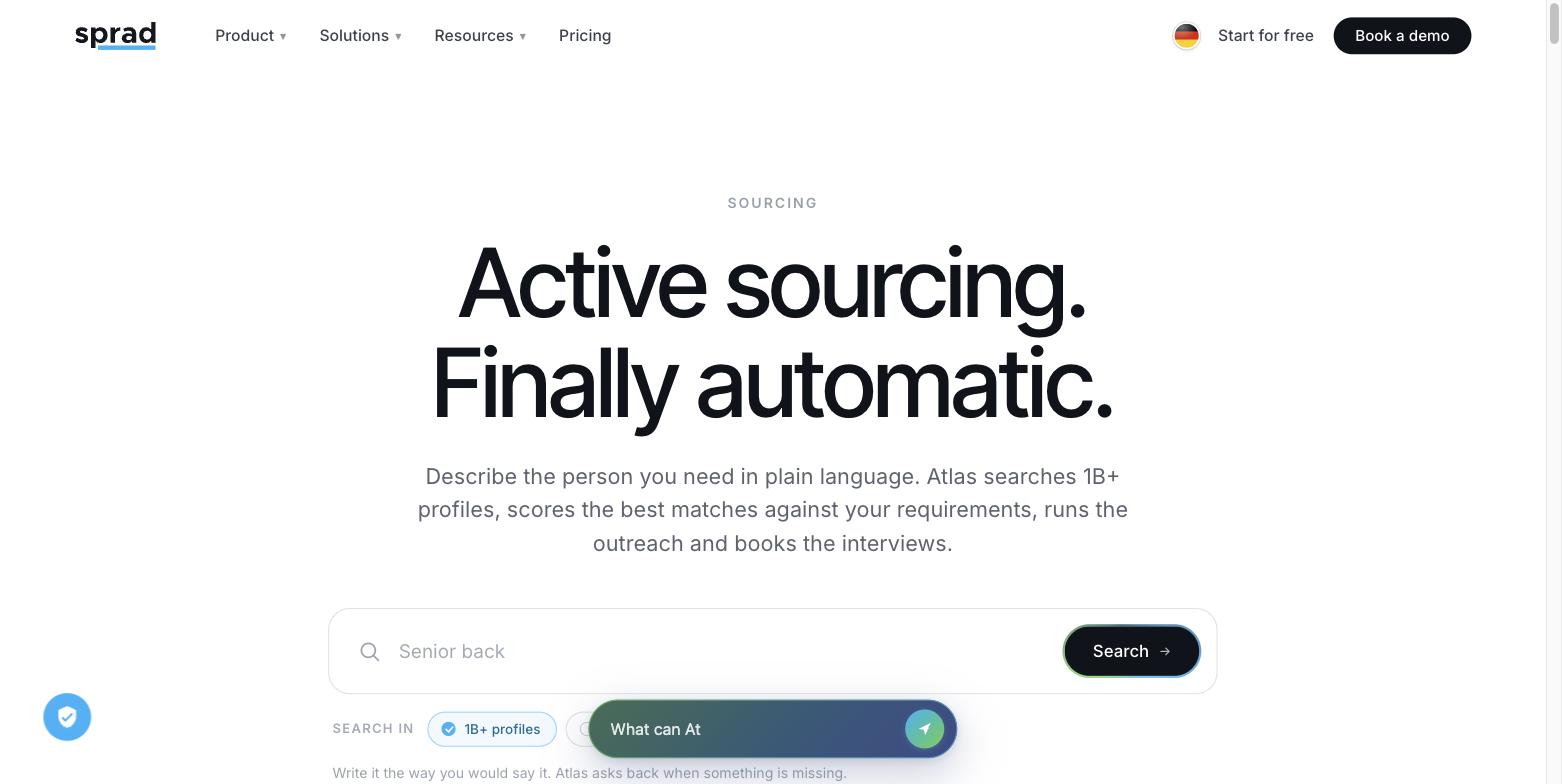
Instead of restricting search to one shared network, Sprad reads full candidate profiles against a plain-language requirement description across more than a billion public profiles plus the agency's own talent pool, in a single search — and that pool stays with the agency even after cancelling. See a closer, feature-by-feature look in our Sprad vs. LinkedIn Recruiter comparison.
hireEZ — GitHub-native sourcing for tech roles
G2 reviewers single out the GitHub integration as a "game-changer" for technical sourcing. More detail in our LinkedIn Recruiter vs. hireEZ comparison.
SeekOut — diversity and specialist sourcing at scale
The stronger option for diversity-focused or specialist sourcing — patent authors, security-cleared personnel — at mid-market and enterprise scale. More detail in our LinkedIn Recruiter vs. SeekOut comparison.
For the full field, see our LinkedIn Recruiter alternatives guide.
FAQ
What is LinkedIn Recruiter's rating on G2 and Capterra?
4.5 out of 5 on both platforms — 420 reviews on G2, 134 on Capterra, as of September 2026.
Is LinkedIn Recruiter worth it for a small agency?
Reviewers themselves question the ROI under five seats, and agencies doing volume sourcing typically need the unpublished-price Professional/Corporate tier to get ATS integration and unlimited InMails.
What do users complain about most with LinkedIn Recruiter?
Cost relative to team size, declining InMail response rates as a shared pool becomes saturated, slow performance under heavy filtering, the lack of exportable candidate data, and the fact that identical searches return largely identical shortlists to different recruiters.
What's the real InMail reply rate, not the advertised one?
LinkedIn publishes a 10-25% range, but a 2025 study across more than 20 million InMail sends (Belkins) measured an overall reply rate of 6.4% — a useful number when weighing a fixed monthly seat cost against actual replies.
Has LinkedIn Recruiter's price gone up in 2026?
Yes — roughly 15%, on top of an InMail cap and shared candidate pool that haven't changed, which is why the "ROI unclear under 5 seats" complaint has gotten louder rather than quieter this year.
What's a good alternative if LinkedIn Recruiter feels too narrow?
Sprad searches over a billion profiles plus your own pool in a single run instead of restricting sourcing to one shared network, and its pricing scales with actual usage instead of a flat per-seat fee.
The 3-minute version
LinkedIn Recruiter earns its 4.5/5 on both G2 and Capterra for reach and ease of use, but its own reviewers keep naming the same limits: cost that doesn't shrink for small teams and just rose again in 2026, a real reply rate well below what's advertised, and candidate data — plus candidate uniqueness — that never really leave LinkedIn's shared pool. Sprad's answer is a search across LinkedIn-scale data plus your own network, priced by usage rather than by seat, with a pool that stays yours. Start free with 200 credits a month, no credit card required, at sprad.io/industry/recruitment-agencies.
Jürgen Ulbrich
Jürgen Ulbrich has more than a decade of experience in developing and leading high-performing teams and companies. As an expert in employee referral programs as well as feedback and performance processes, Jürgen has helped over 100 organizations optimize their talent acquisition and development strategies.