To post a job on Facebook, publish it for free on your business Page, or run it as a paid ad in Meta Ads Manager for far more reach. Facebook's free Jobs tool was shut down in most countries in 2022 and survives mainly in the US and Canada, so for most employers it is a Page post or an ad. Paid job ads must use Meta's "Employment" ad category, which restricts targeting heavily. As of October 2026.
Where can you publish a job on Facebook?
| Route | Cost | Reach | Best for |
|---|---|---|---|
| Post on your business Page | $0 | low, mostly existing followers | an extra channel, employee sharing |
| Facebook groups (local, trade) | $0 | medium, follow group rules | trades, care, local roles |
| Paid ad in Ads Manager | ad budget | high, steerable by location | any role you need to fill fast |
| Facebook Jobs / Local Jobs | $0 | US and Canada only | not available in most countries |
Posting only on your own Page reaches few people beyond your followers. It works for an employee network, not for an urgent hire.
The Employment ad category: what it does to your targeting
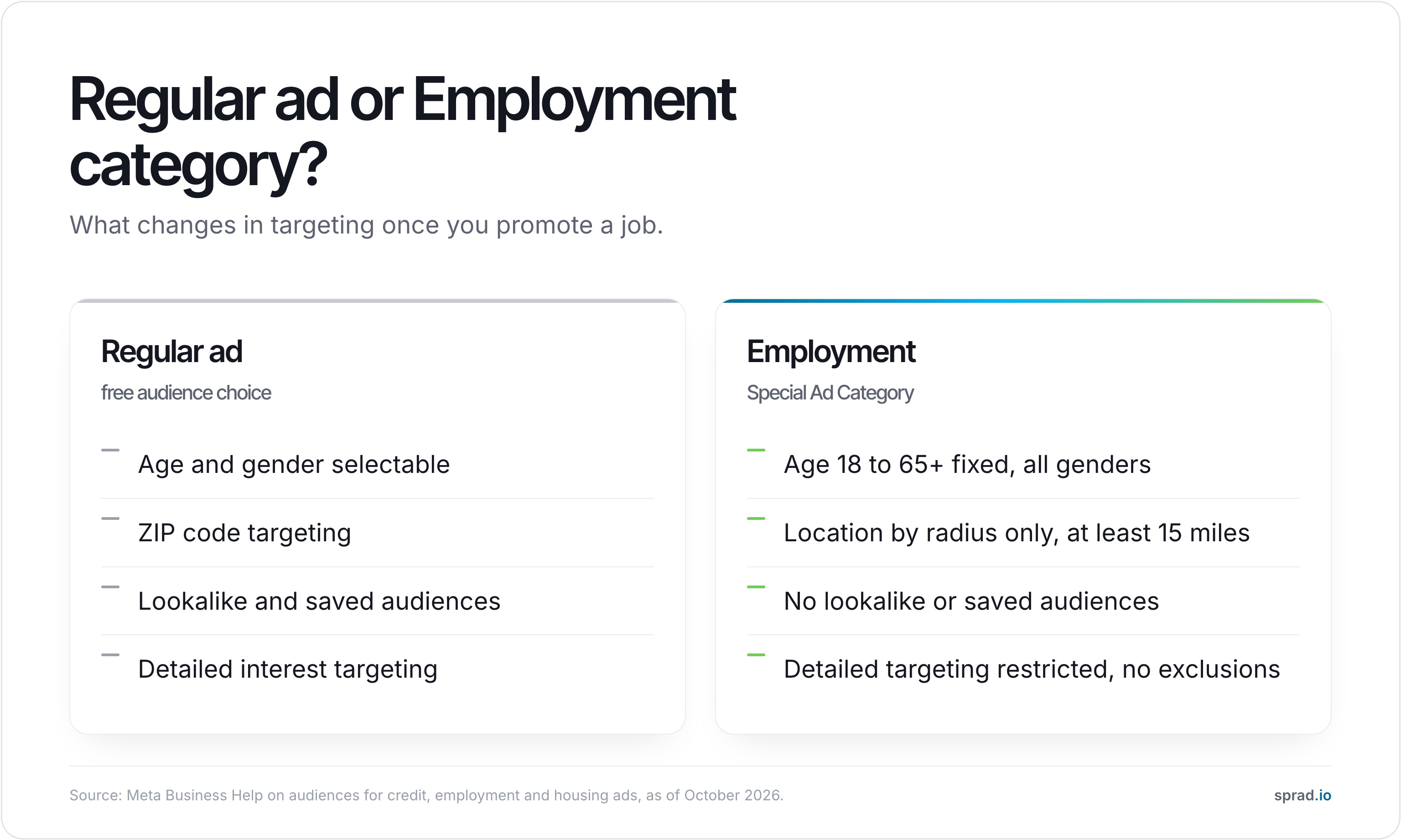
As soon as an ad promotes a job, you must select the "Employment" Special Ad Category. Meta introduced it to prevent discrimination. Per Meta Business Help it applies to advertisers in the US, Canada and parts of Europe. Check the current scope in Ads Manager when you set up a campaign.
In practice:
- Age and gender cannot be set; the ad runs to ages 18 to 65+ and all genders.
- Location works as a radius only, at least 15 miles (25 km), not by ZIP code.
- Lookalike and saved audiences are unavailable, detailed targeting is limited, and exclusions are not possible.
- If you skip the category, the ad can be paused, because Meta detects job ads automatically.
What this means for your ad: the audience is no longer built by filters but by ad copy, image and location. If you state "CDL-A driver, Dallas area, night shift" clearly, the ad filters for you. That is why copy and pre-screening matter more here than with any other advertising.
How to post a job on Facebook, step by step
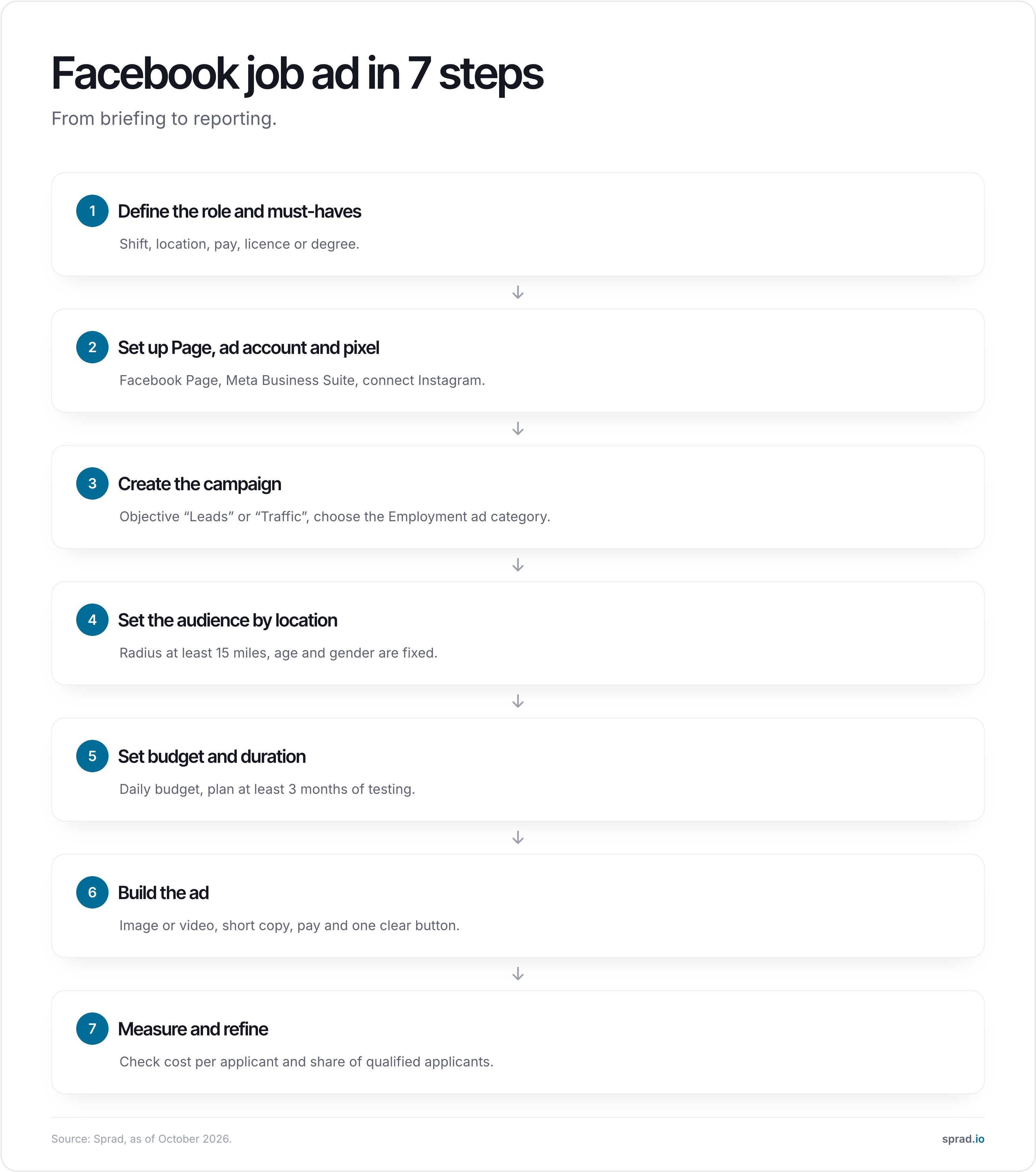
1. Define the role and must-haves
Write down what applicants need: shift, location, pay, licence or degree. These details go into the ad copy.
2. Set up Page, ad account and pixel
You need a Facebook Page, an ad account in Meta Business Suite and ideally a connected Instagram account. If you serve EU candidates, the Meta pixel and lead forms require consent under GDPR; check with your data protection officer (this is not legal advice).
3. Create the campaign and choose the category
Pick the objective "Leads" (instant form) or "Traffic" (landing page) and set the Employment category.
4. Set the audience by location
Set the location as a radius around the workplace, at least 15 miles. For rural regions that is often what you want anyway.
5. Set budget and duration
Technically a few dollars a day are enough. For usable data plan at least three months; Sprad also recommends this period. The budget is spread across your roles.
6. Build the ad
A real photo from the workplace, one sentence on the role, the pay and a clear button. Only the first 125 characters show in the feed, so put role and location there.
7. Choose the application route
| Route | Upside | Downside |
|---|---|---|
| Instant form in Facebook | few taps, many applications | many poor-fit applications |
| Landing page with short application | own questions, better quality | more drop-off |
| WhatsApp or Messenger | familiar route for shift work | needs fast replies, check the rules |
For frontline roles, phone and WhatsApp beat email; see frontline recruiting by phone and WhatsApp, not email.
What does a Facebook job ad cost?
A Page post costs nothing; a paid ad costs the budget you set. A solid US reference: Boostpoint analysed 891 campaigns in 2026 and found a median of $13.88 per applicant, ranging from $2.14 for warehouse roles to $74.62 for therapy roles. Your results can differ.
Worked example with the US median: a $1,000 budget yields roughly 70 applicants, $5,000 for five roles roughly 360. With Sprad Social Recruiting a 10 % fee is added, so €1,100 for a €1,000 budget. Not every applicant fits, so the share of qualified applicants matters more than the raw count.
Sample ad copy for a Facebook job ad
CDL-A truck driver, Dallas area
Fixed routes, weekends off, $28 an hour plus overtime. Apply in two minutes from your phone, no resume needed.
Role and place come first, pay makes the decision easy, and the application route is short. Adjust the numbers to your role.
Common mistakes with Facebook job ads
- Not choosing the Employment category and getting the ad paused.
- Trying to force age or gender targeting instead of steering with copy and location.
- Leaving out the pay, the strongest hook for shift work.
- A long form with a resume upload.
- Switching off after two weeks, before the algorithm has learned.
- Not answering applicants within a day.
The route without campaign work: Sprad Social Recruiting
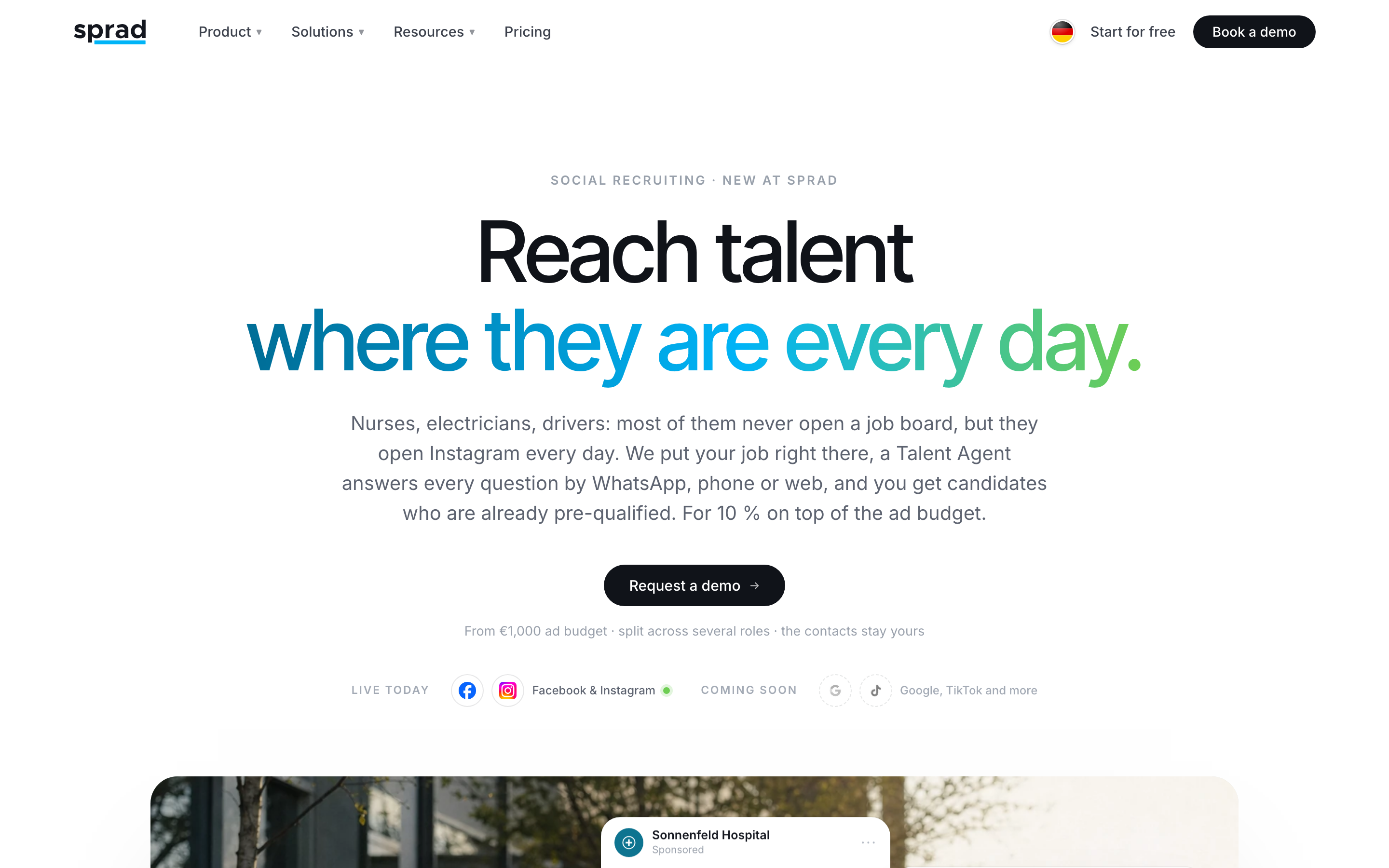
If you do not want to build ads, pre-screening and a talent pool yourself, use Sprad Social Recruiting. Sprad runs your roles on Instagram and Facebook, an AI talent agent pre-screens every applicant via WhatsApp, phone or web, and every applicant lands in your own talent pool. You pay ad spend plus 10 %, from €1,000. Industry examples: logistics and trades.
FAQ
Can I post a job on Facebook for free?
Yes, as a post on your business Page or in groups. Reach is limited. The Facebook Jobs tool is only available in a few countries.
Why can't I set the age on my job ad?
Because job ads fall under the Employment ad category. Age, gender and ZIP code are not selectable there; location works as a radius only.
How much budget do I need for one role?
A few dollars a day is technically enough. For reliable results plan about $1,000 over three months per role group, more for several roles.
Which is better: instant form or landing page?
The form brings more applications, the landing page better ones. Test both with half the budget each.
Does this work for nurses, tradespeople and drivers?
Yes, these groups are on Facebook and Instagram every day. Pay, location and a short application route are what matter.
More on social recruiting
Jürgen Ulbrich
Jürgen Ulbrich has more than a decade of experience in developing and leading high-performing teams and companies. As an expert in employee referral programs as well as feedback and performance processes, Jürgen has helped over 100 organizations optimize their talent acquisition and development strategies.