HiringUse CasesCandidate Portal

Application 2.0

👋 Goodbye AI-generated CV.

Every applicant gets their own portal instead of a black box: a live roadmap, preparation before the interview, a decision with honest feedback — and a profile they keep. You get context no document can give you.

Nothing shared before they release it EU hosting · GDPR Plugs into your ATS
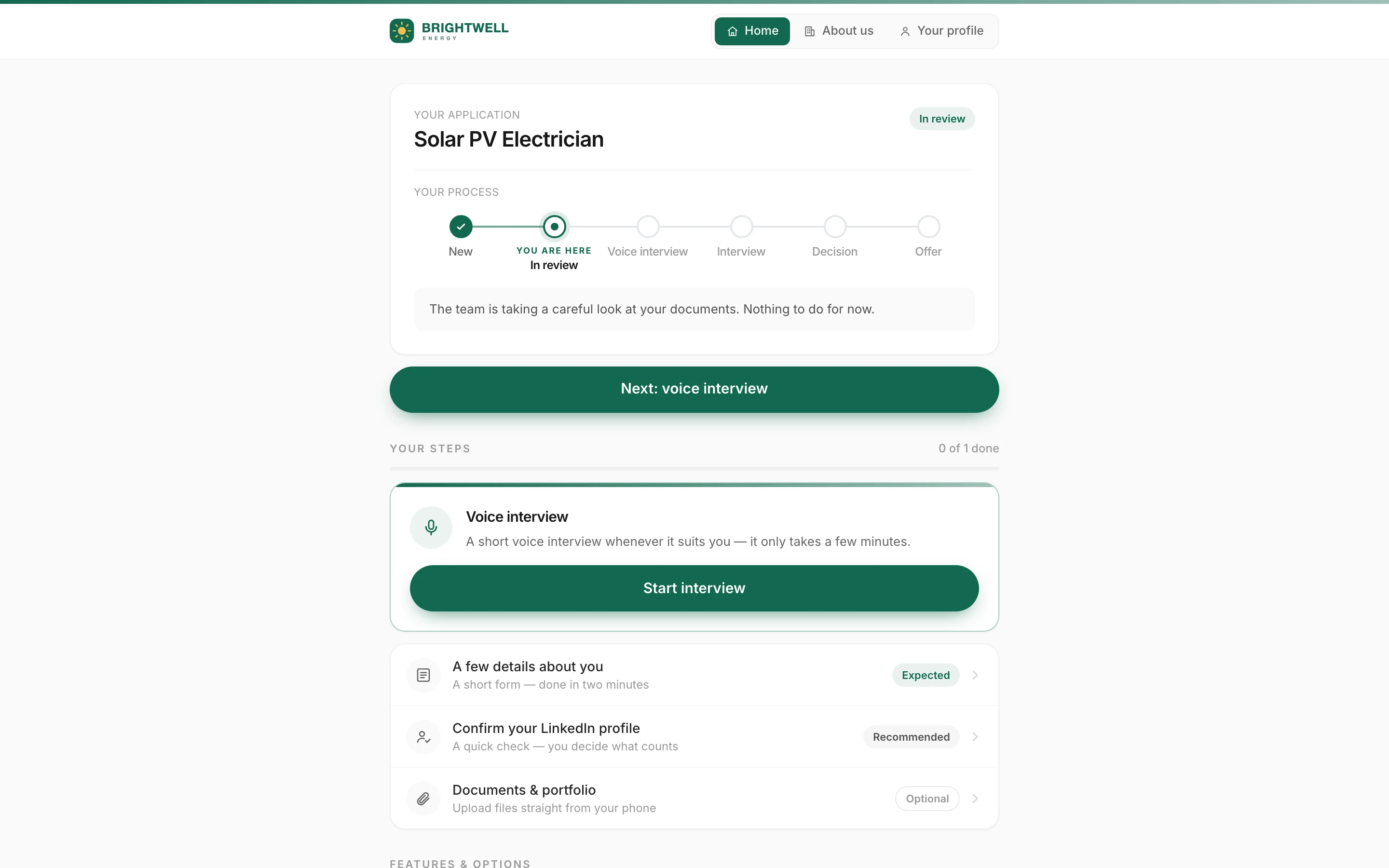
The candidate portal on desktop: the application header card with the process roadmap and the current step, the voice interview as the highlighted action, and the remaining steps as a list.
The same portal on a phone: the invitation that takes candidates into their personal portal, with the role they applied for and the button to open it.
Same portal. Your brand, your domain.

The CV stopped being a signal.

Three things broke at once — and a portal fixes all three, because it gives the candidate a reason to hand you more than a document.

Everyone looks perfect on paper

Alina ParkService Technician
95% match
Daniel FunkService Technician
95% match
David SchmidtService Technician
95% match

Every application is AI-polished, so every score lands in the same narrow band. Ranking CVs against each other stopped telling you anything.

Silence costs you the good ones

Lena VogtApplied 19 days ago waiting
Tom ReiterTook another offer gone
dropped

While your process runs, the strongest candidates take the offer that answered first. Nothing in a standard funnel gives them a reason to wait.

A rejection ends the relationship

“Any feedback for me? I'd apply again.”
Employer
Petra LangRejected · unreachable since

Almost everyone who applied gets a no — and becomes a stranger again. Next role, you start from zero and pay for reach twice.

What the portal changes

Same candidate. Four times the ground to stand on.

Not a better score — more sources. Every station adds something the last one couldn't see, and the candidate confirms it themselves.

CV onlySelf-reported, one document
1 source
+ Application formHard facts, structured
2 sources
+ Voice interviewAnswers, role-plays, quoted evidence
5 sources
+ Candidate portalConfirmed profile, verified links, own questions, released by them
8 sources

And it keeps working after the decision. The profile stays with the candidate, stays current, and stays findable for your next role.

See it live

An example flow

How it could run at yours.

One possible sequence — every station is a building block you can switch on, switch off or reorder to fit the role.

optional Switch it off and the flow simply skips it.

Station 01

The application lands in your ATS

People apply the way they always did — job board, career site, referral, sourcing. Sprad watches the ATS and picks up every new application the moment it arrives. No second inbox, no parallel process.

Station 02

The invitation goes out — WhatsApp or email

Sent straight out of the ATS, in your branding and the candidate's language. One link, no account to create, no app to install. The WhatsApp message is usually opened within minutes; email stays the fallback for everyone else.

Station 03optional

The candidate takes the first step

They confirm what you already know and add what the CV never asked for: earliest start, notice period, certificates, what they actually want next. Two minutes of their time — and the first facts in your file that nobody had to chase.

Station 04optional

The voice first interview

A structured conversation instead of another form — follow-up questions, role-plays, in the candidate's own language. Identity details are removed before anything is assessed, every rating points back to a quote you can read, and a person makes the decision.

Station 05optional

They book the team interview themselves

Your calendar, their choice. No email ping-pong, no three days between "we'd like to meet you" and a date in the diary. The slot lands in both calendars with the joining details already attached.

Station 06

A decision with honest feedback

Yes or no, the portal says it plainly — and says why, in language a person can use. Written once, sent the same day, tied to what actually came up in the process. That is the part candidates remember, and the reason they stay reachable.

Station 07optional

They stay in your talent pool

The profile belongs to the candidate and stays current, because they have a reason to keep it that way — it is the same profile they use for their next application. When your next role opens, you start with people who already know you.

Seven stations here — your flow uses the ones that fit.

Book a demo

Inside the portal

Eight things the candidate can actually do.

Not a status page. A place where the next step is always obvious, and where handing you more is worth their while.

A live process roadmap

Every step, what is done, what comes next and roughly when — so nobody has to write "any update?".

Interview prep with Atlas

Questions about the role, the team, the site, the shift model — answered before the interview instead of after it.

The voice interview as a station

Not a link in an email that gets lost — a station in the portal they can start when it suits them.

Booking their own slot

Live availability from your calendar. No ping-pong, no lost days between "let's meet" and a date.

Your company page, with benefits

Who you are, how you work, what people get — in the same place as their application, not three clicks away.

A CV they can structure and export

Everything they confirmed becomes a clean, structured profile they can take with them — theirs, not yours.

The release control

Each item is theirs to release. What is switched off never reaches you — and they can change their mind later.

Passing the role on

A no can still bring you someone. Candidates can recommend a person they rate — from inside the portal, in two taps.

Easier to grasp with a live portal in front of you.

Try it live

One portal, every kind of role.

Same portal, same building blocks — switched on or off for the role you are filling.

White collar

People confirm their profile, add a verified LinkedIn, try the AI role-play and book a slot themselves. No voice call needed.

Building blocks Confirm profile LinkedIn, verified AI role-play Book a slot Voice interviewoff

IT & software Professional services Public sector

High volume

Everyone gets a voice interview first, the key facts are settled inside it, and your shortlist is ready the same day.

Building blocks Voice interview Key facts check Same-day shortlist LinkedIn, verifiedoff Documents & portfoliooff
Retail Hospitality Logistics Staffing

Hard to fill

A link often goes unclicked here, so the voice interview arrives as a phone call — and everyone stays in your talent pool.

Building blocks Voice by phone call Key facts check Talent pool Portal link as entryoff Documents & portfoliooff
Healthcare Trades Manufacturing

Pricing

The portal costs nothing. You pay for outcomes.

Everything runs on credits, and a credit is only spent when a step actually runs. Give the portal to every applicant and switch on screening or an interview only where it earns its keep.

No user licences — invite the whole hiring team No minimum term No setup fee
What a run actually costsOrders of magnitude
Candidate portal, roadmap, feedback, talent poolEvery applicant, every role, for as long as you use Sprad. Free
CV and skills screeningPer application, only for the roles you switch it on for. Centsper application
A guided voice interviewBilled by the minute — a short conversation costs less than a long one. A few eurosper interview, by the minute
From volume onwardsThe more interviews you run, the lower the rate per interview. Lessthe more you run
Nothing else on the invoice. No seats, no platform fee, no annual commitment.

The exact rates are on the pricing page — in a call we run them against your real volume.

For the hiring team

What the portal does for you.

Four things that change

You judge evidence, not a document

Eight sources sit in one profile — the conversation, the verified profile, the role-play, the documents. Every rating hangs on a quote you can read back.

The chasing disappears

Inviting, reminding and scheduling run by themselves. Your team writes one message per applicant: the decision, in its own words.

Fewer people drop out halfway

All seven stations are visible to the applicant, including where they currently stand. Nobody goes quiet because nobody is left guessing.

Your pool keeps its value

Everyone who went through the portal stays reachable with their evidence attached — and four release switches keep it their choice what you may keep.

Hold these four against your own funnel.

See it live

Data control

Their data. Their call.

A portal only works if the person inside it trusts it. So the defaults belong to the candidate, and every one of them is reversible.

Release controlEach item is switched on by the candidate. What is off never reaches your team — and can be switched off again after the fact.
Export any timeThe full profile — confirmed facts, interview summary, feedback — as a file they keep. It is their record of the process, not only yours.
Deletion in one stepOne button removes the profile and everything attached to it. No support ticket, no waiting period, no dark pattern in the way.
Hosted in the EUData stays on EU infrastructure, on certified hosting, with the documentation your DPO and works council actually need.
No model trainingCandidate data is never used to train models. It exists to run this one process for this one employer, and nothing else.
FAQ

What teams ask before
switching it on.

Do candidates have to create an account?
No. They get one personal link by WhatsApp or email and are in. No password, no app, no download. If they lose the link, a new one is one message away — and everything they already did is still there.
Does this replace our ATS?
No — but you don't need one to start either. We bring a lightweight applicant tracker of our own, and if you have no system yet you can use it free of charge. Most of our customers already run something, and they keep it: the ATS stays the system of record, applications arrive there, statuses live there, the hire is booked there, and everything the portal collects flows back into the application record your team already works in.
Does every applicant have to use the portal?
That is your call. Most teams make it a fixed part of their process — the portal is where you apply, confirm your details and book your interview — and that is where the benefit sits: one place, every applicant, the same picture for your team. Candidates take it as normal, not least because the invitation is one link with no account to create. If you would rather offer it alongside your existing route, that works too, and a single person who cannot use it can always be handled by phone.
Who sees what, and when?
The candidate releases each item individually — confirmed profile, interview transcript, certificates, salary expectation. What is switched off never reaches your team, and a release can be withdrawn later. On your side, access follows the roles you already have in the ATS.
Can we run it fully in our own branding?
Yes. Logo, colours, your own subdomain, your sender name on WhatsApp and email, your tone of voice, and the languages you hire in. Candidates never see a Sprad login screen.
How long does setup take?
Connect the ATS, pick one role, adjust the station names to how you actually hire, approve the invitation texts — that is a matter of days, not a project. Most teams start with a single role, then roll it out once they've seen the first cohort go through.

Give every applicant a reason to stay in the process.

Thirty minutes, one of your own roles, no slide deck.

Starting is free — see what it costs →

EU hosting · Works with your ATS